Are You Ready?
Is Your Business Ready for AI?
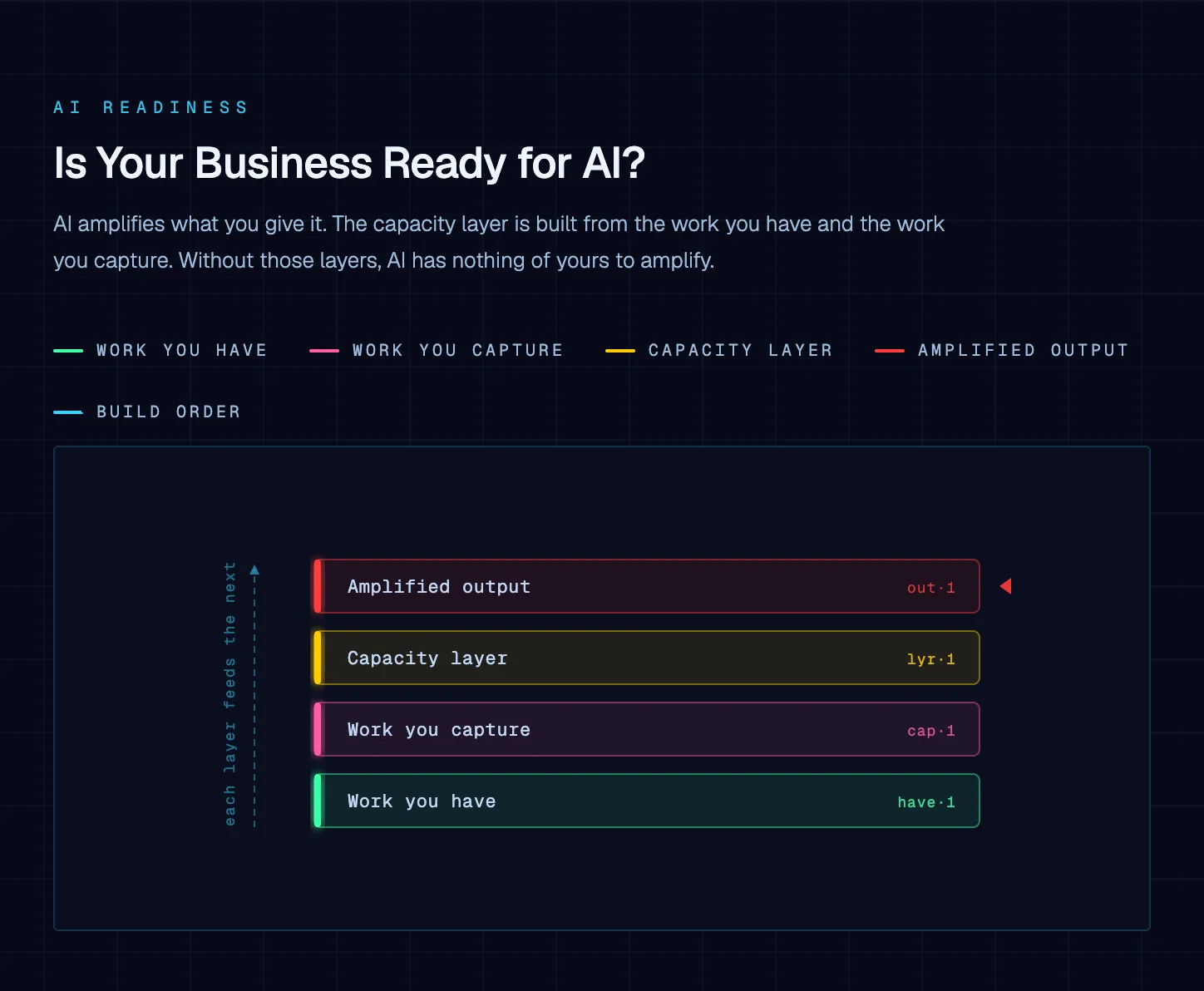
AI reads your business through your body of work. Two things decide whether it can help you: whether AI can read the work you've already built, and whether you're keeping the work you produce from here on. Most businesses fail both. The questions below show you where you stand.
Sound familiar?
Workshops, Tools, Generic Output
You've sat through the AI workshops. You've tried ChatGPT. The output sounds generic because it is.
Proposals in Google Drive. Contracts in Dropbox. Sales calls in Otter, or never recorded. Customer feedback in email threads. A few critical spreadsheets on a laptop. The rest in your head.
The workshops taught prompts and tools. They skipped the part that makes prompts work: a body of work AI can read, and a way to keep what you produce so that body of work grows.
The Frame
AI Can Only Amplify What It Can Reach
AI reads your business through your body of work. Two things decide whether it can help you.
Whether AI can reach the work you've already built. Your proposals, reports, notes, and spreadsheets are what AI draws from. When they're scattered, badly named, or stuck in formats AI reads slowly, AI works from fragments and hands you fragments back.
Whether you keep the work you build next. Every call you don't capture, every decision that lives only in your head, every deliverable that never lands somewhere AI can reach: that work evaporates. A body of work that stops growing stops compounding.
Diagnostic A: What AI Can See
Can AI Read What You've Built?
Walk through these honestly. They're the same checks the Audit runs against your files.
1. Can a Stranger Tell What a File Is From Its Name?
A well-named file says what it is in the name. Client-Acme-Proposal-2026-03.pdf is a name. Final_v3_REAL.pdf is filler. So are initials, project codes, and dates with no year. They work because you remember the project. AI cannot remember. AI reads the name. If the name doesn't say, AI doesn't know.
2. Does Your Body of Work Live in One Place, or Scattered Across Drives?
Email attachments, Google Drive, Dropbox, OneDrive, a desktop, a hard drive in a drawer. The same proposal sits in four locations with three names and two versions. Until your body of work lives in one place a computer can read, AI sees fragments instead of a body.
3. Are Your Files in Formats AI Reads Efficiently?
AI reads some formats fast and cheap, others slow and expensive. A markdown file is read in seconds. A scanned PDF runs through optical character recognition with errors. Format decides what AI can do with your content and what each query costs. Full breakdown on the file formats page.
Diagnostic B: What You're Keeping
Are You Keeping the Work You Produce?
The first three questions look backward, at what you have. These look forward, at what you're about to lose.
4. Are Your Sales and Client Calls Captured, or Gone When the Call Ends?
The pricing objection a client raised, the feature they asked for, the way you talked them through a decision. When the call isn't recorded or transcribed, that knowledge leaves with them. AI can't amplify a conversation no one wrote down.
5. Do Your Decisions and Processes Live Somewhere, or Only in Your Head?
How you scope a project, price a job, handle a difficult client. You run it from memory. The day you want AI to do it the way you do it, there's nothing for it to read.
6. Does the Work You Finish This Week Feed the Layer, or Pile Up Where AI Can't Reach It?
A finished proposal, a project report, a client deliverable. When it lands in a folder AI never sees, it adds nothing to what AI can amplify next time. Work that isn't captured evaporates. Work that is captured compounds.
What your answers mean
Two Outcomes, One Next Step
If you answered yes across both sets, you're in rare shape. Your body of work is set up for AI to amplify, and you're keeping what you produce. That's a moat most of your competitors don't have. The Capacity Build runs fast for you, straight toward output no competitor with the same AI tools could produce.
If you didn't, you're where most small businesses are. The material exists. The structure doesn't, and the work you produce keeps evaporating before AI can use it. Closing both gaps is what the Capacity Build does.
Either way, the next move is the same conversation: thirty minutes with Jason to look at your body of work together and decide where to start.
Book a DiscoveryThe Capacity Build
Where Readiness Fits in the Build
The diagnostic is the front door to a five-stage process called the Capacity Build.
Audit reads your body of work and names what it takes to activate it. Prepare restructures your files into formats AI reads. Capture builds workflows so every action going forward feeds the layer instead of evaporating. Activate produces business output AI couldn't otherwise produce. Compound expands the layer cycle over cycle, each one sharper than the last.
The first three questions you answered map to Audit and Prepare. The last three map to Capture. See the full process and pricing on How It Works.
Next step
Thirty Minutes With Jason
We walk through your body of work, what AI hasn't done with it, and the first move for your business. Jason has spent thirty years across industries and teaches AI as a professor at Montclair State University. If the Capacity Build is the right fit, you'll know. If it isn't, you'll know that too. Most people leave with something to act on either way.
Book a Discovery