Prepare
Best File Format for ChatGPT: Why PDFs Cost More Than You Think
PDFs are the most expensive and least reliable format for AI work. Here's what the numbers show – and the conversion workflow that fixes it.
If you’re loading PDFs into ChatGPT, you’re paying more and getting less than you need to.
PDF is the default format most businesses use for documents – proposals, reports, contracts, research. It’s familiar, it looks professional, and it preserves formatting. It is also the most expensive and least reliable format for AI work. The gap between what a PDF costs in an AI session and what a markdown file costs for the same content is significant. For a single large document, it can mean the difference between a model that can process the file and one that cannot process it at all.
Here’s what the numbers look like.
Why File Format Matters
When you load a document into an AI chat session, the model doesn’t read it the way you do. It processes it as tokens – chunks of text that consume space in the model’s context window, the limit of how much it can hold in a single session.
PDFs are bloated for this purpose. They carry hidden formatting code, embedded font data, layout instructions, and structural markup that a reader never sees but a model has to process. A markdown file containing the identical words is a fraction of the size – and a fraction of the cost.
Markdown is a lightweight text format. It uses simple symbols to indicate structure: a # marks a heading, ** wraps bold text, a - creates a list item. Strip away the hidden formatting that PDFs carry and replace it with those simple markers, and the file becomes clean, compact, and efficiently processed by any AI model.
The difference affects whether the model can read your file, how much it costs to process, and how many documents you can load into a single session.
A Case Study: The Same Book, Two Formats
To measure the difference precisely, one document was tested in both formats: a 307-page book, loaded first as a PDF and then as a converted markdown file.
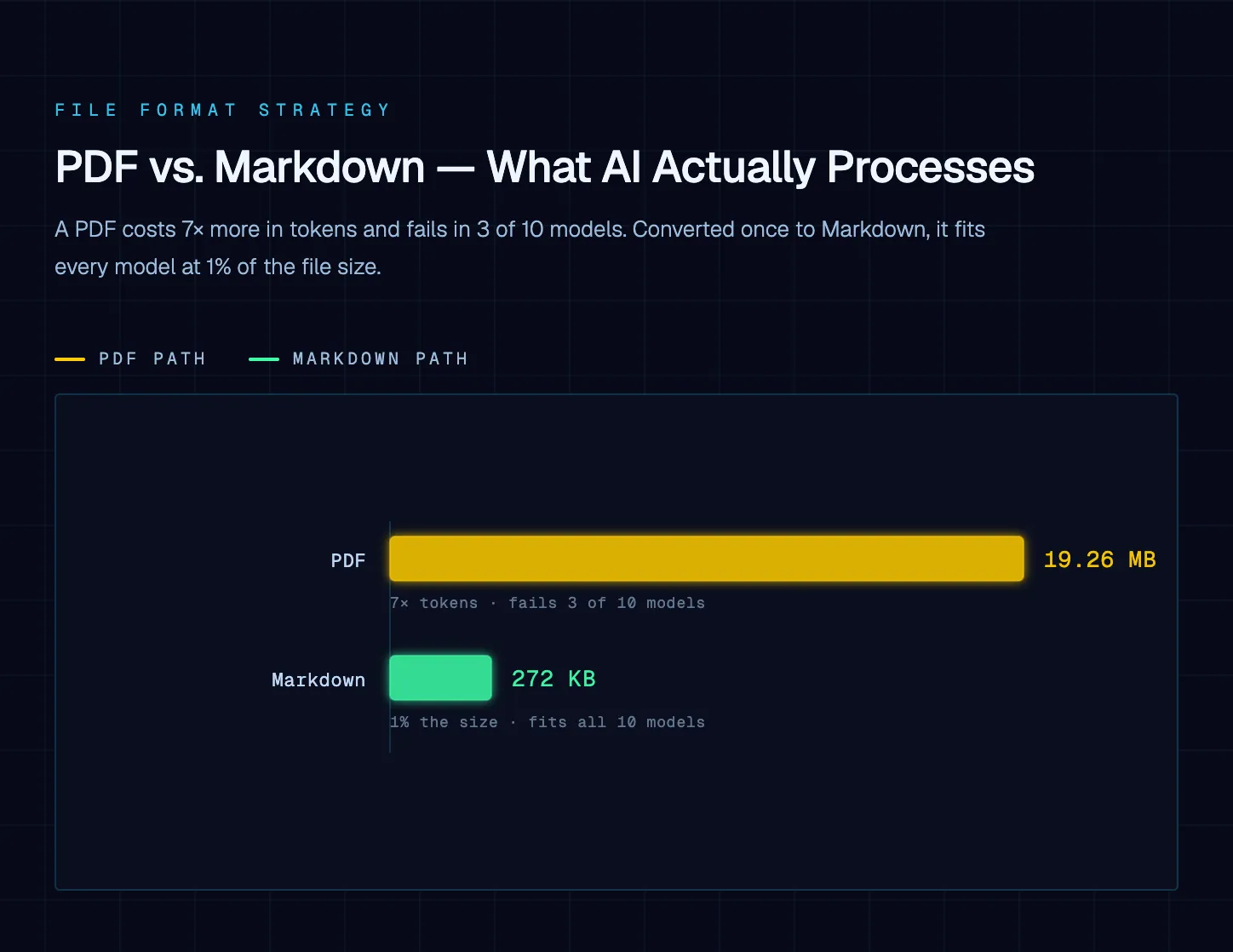
The file size: The PDF was 19.26 MB. The markdown conversion was 272 KB. That is a 73:1 ratio – the same content, in a format AI processes more efficiently, at roughly 1% of the original file size.
The token cost: Token cost is what you actually pay in an AI workflow. The PDF required 7 times more tokens than the markdown file to convey the same content. Across ten sessions a month, that multiplier adds up.
The model compatibility test: Ten current production AI models were tested against both versions of the same document. Three of those ten models – including models from major providers – could not process the 307-page PDF at all. The document exceeded their context window entirely. The markdown version fit cleanly in all ten.
One additional finding: pricing structure varies by provider. One major platform’s tiered pricing model produced a 13:1 cost ratio for this document rather than the 7:1 average – meaning the format choice had nearly double the financial impact on that platform specifically.
The case study used a clean, text-layer PDF – one where the text is selectable and readable by a machine. For scanned documents or image-heavy PDFs where the text has been photographically captured rather than digitally stored, the ratio is not 7:1. It approaches 1,000:1. Scanned PDFs require optical character recognition (OCR) before any conversion is possible. The case study numbers are the conservative end of what the format gap looks like.
What to Do With Your Documents
Any document your business uses regularly – proposals, reports, contracts, research, program materials – should exist as a markdown or plain text file. That is the AI-native version. Conversion is preparation – the one-time work that makes the file ready for every session it will appear in. PDFs stay where they belong: for printing, for sending, for visual presentation. The markdown version is what goes into the AI session. That’s activation.
Three Things to Take From This
PDF is the most expensive format for AI work. It was designed for printing and visual presentation. AI models process it at a cost penalty – in tokens, in dollars, and in some cases in capability. The format choice matters.
The fix is a one-time conversion that compounds. Convert a document to markdown once and the cost reduction applies to every session it appears in, indefinitely. For a document used regularly – a standard proposal template, a product specification, a program overview – the conversion pays for itself immediately.
Know which kind of PDF you have before you convert. A text-layer PDF converts cleanly and produces the 7:1 ratio or better. A scanned PDF requires OCR first. The simplest test: if you can highlight and copy text from the PDF in a standard reader, it’s text-layer and ready. If you can’t, it needs OCR before conversion.
Related Reading
Once documents are in the right format, loading them into a structured project changes what AI can do with them – ChatGPT knowledge base covers how a converted document archive becomes a knowledge asset rather than a file pile.
The format question applies before any data analysis session starts – ChatGPT for data analysis shows how the file going into the session determines what the analysis can produce.
Meeting transcripts have their own format considerations before they become source material – AI meeting notes covers how recordings get from audio to something an AI session can work with.
Need Help Converting Your Files to AI-Native?
Book a 30-minute AI Discovery Call. We’ll audit the documents your business already uses and identify what needs to be converted – and what that unlocks. No deck, no pitch, no obligation.