Activate
ChatGPT for Data Analysis: Generic Results Are a Data Problem, Not an AI Problem
ChatGPT produces generic analysis when it doesn't know your business. Here's what changes when you load your own data — two real examples with concrete results.
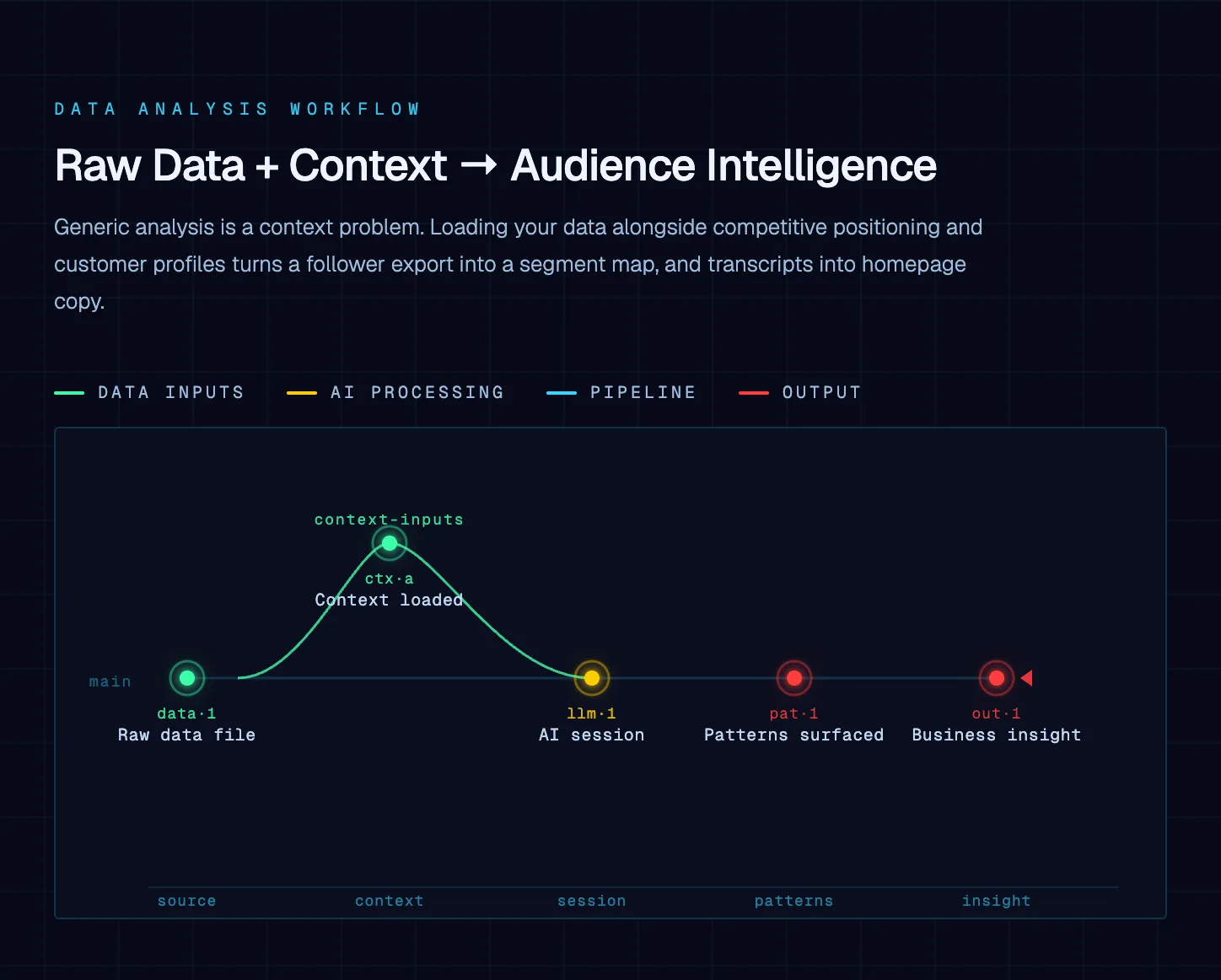
When ChatGPT gives you shallow analysis, the problem is what wasn’t loaded into the session.
ChatGPT has never heard of your business. It doesn’t know which customers matter most, which numbers signal trouble, or what your competitive position looks like. Without your context loaded alongside it, you get analysis built on everything except what’s specific to you. The output is plausible. Because it doesn’t belong to anyone.
Load your own data – your customer records, your audience files, your feedback history – and the analysis stops being generic. It starts being about your business.
That’s activation: the body of work your business has already produced, loaded as context AI can draw from.
Two examples show that difference: a LinkedIn follower analysis that found an audience the business didn’t know existed, and a member sentiment analysis that rewrote a company’s homepage by finding what customers meant, not just what they said.
Why the Analysis Stays Generic Without Your Data
ChatGPT is a pattern-matching engine trained on a large slice of the public internet. When you ask it to analyze a spreadsheet or summarize a dataset without context, it pattern-matches against everything it knows about similar data from similar industries. The result looks like analysis. It reads like analysis. It has the structure and confidence of analysis.
But it’s about a business that doesn’t exist — some average of every company that ever produced data like yours.
The fix is loading what ChatGPT is missing: the context that makes your data mean something specific. A competitor analysis. A profile of your best customers. Prior research you’ve already done. When those go into the same session as your data, the analysis is constrained by what’s actually true for your business.
A flag of caution: a session can drift from describing what the data shows to recommending what to do — without the data supporting the recommendation. The output sounds confident. But if you ask “where in the data does it say that?” and there’s no answer, you don’t have analysis. You have guesswork formatted to look like analysis. Every claim should trace to a source. Every number should trace to a row.
Two Examples
LinkedIn Follower Analysis: Finding an Audience Nobody Was Targeting
A business wanted to understand who was paying attention to them on LinkedIn. They had assumptions about their audience but no structured picture. They ran a follower export — over 1,100 people in a raw file that would take a person days to sort through manually.
The file went into an AI chat session. But not alone.
They loaded it alongside two things they’d already built: a competitive positioning analysis and a profile of their 19 most engaged community members. Neither was new data. Both were context. Both were prepared work – built before the session began, ready to do their job the moment they were loaded.
The session returned a map: five distinct audience groups with size estimates and representative headlines. A breakdown showing which recent followers were high-signal versus noise. A table showing twelve terms followers were using to describe themselves — and whether the business was using those same words or actively avoiding them.
That table revealed the headline finding. A specific audience — sustainability and regenerative design practitioners — had been arriving for months, drawn by the company’s own language, without any deliberate targeting. Nobody had noticed. The pattern only emerged when the follower file was read against the competitive landscape at the same time.
The business didn’t immediately launch a campaign for that audience. They made sure their positioning choices weren’t inadvertently turning them away. Most audience analyses don’t have the context to surface that kind of finding. This one ran in under an hour. Building the same picture manually — reading 1,100 profiles, cross-referencing a competitor analysis, and mapping the language gaps — would have taken days and a budget to match.
Member Sentiment Analysis: What 38 Transcripts Said That Surveys Never Would
A second business ran a paid community. They had long-term members, regular events, and a sense that something valuable was happening. What they didn’t have was a clear picture of why members stayed.
Survey answers for a question like “why do you stay?” produce predictable results. Valuable content. Good community. Useful connections. Those answers are true and useless at the same time. The most effective website copy uses the customer’s own words — language they recognize because they said it first. When visitors read their exact concerns and desires reflected back at them, they convert. Surveys give you categories. Transcripts give you the words.
They had 38 recorded event transcripts – captured as a matter of practice over the life of the community. All 38 went into the session.
The question wasn’t what members said. It was what the pattern of what they said revealed about what they were actually looking for.
The analysis looked for what members described as relief — the language they reached for when talking about what had changed for them. Five consistent patterns came back. Members had spent years in professional environments where they couldn’t operate at full capacity. The community was the first place that changed that. The recurring language wasn’t about belonging or networking. It was about finally being able to think without simplifying.
The website copy that followed dropped two words it had been relying on: belonging and community. For this group of members, those words called up the wrong associations — places they’d already tried that didn’t deliver. The copy used the language members had actually used when describing the experience. The feeling of it, not the category.
A survey asking “what do you value about this community?” would never have surfaced that distinction. Thirty-eight transcripts read for the gap between what members said and what they kept returning to — that produced something a survey can’t.
Three Things That Carry Across Both Examples
What the data sits next to determines what the analysis can see. Neither result came from the data file alone. The follower analysis worked because it was read against the competitive landscape at the same time. Isolated data produces isolated insight. Data loaded in context produces intelligence.
ChatGPT finds patterns in qualitative and messy data better than it calculates precise figures. Both examples used it for pattern-finding — not computation. That’s the distinction. When the job is reading volume for signal, it delivers. When the job is calculating, it needs verified outputs and often a different tool entirely. Know which one you’re asking it to do before you start.
Every claim needs a source it can be traced to. When an analysis produces a recommendation, the right follow-up is “show me where in the data that comes from.” If the answer is nowhere, the recommendation came from the internet, not your data. Building that question into your workflow keeps the analysis honest.
Related Reading
The source material for this kind of analysis has to come from somewhere — AI meeting notes shows how recorded calls and sessions become an organizational data asset you can actually run analysis against.
File format affects both quality and cost before the analysis starts — Best file format for ChatGPT shows when to convert and why the token difference is larger than most people expect.
When the data is incoming customer feedback, the same pattern-surfacing logic applies — ChatGPT for customer service covers what changes when support tickets and feedback threads are read for patterns rather than answered one at a time.
Want to See This in Your Business?
Each of these outputs becomes the next piece of context. The audience map informs the next campaign. The rewritten copy becomes a reference for the next page. The body of work compounds.
Book a 30-minute AI Discovery Call where we audit the data your business already has – audience files, customer transcripts, program records, feedback history – and surface one specific analysis you haven’t been able to do yet. No deck, no pitch, no obligation.