Capture
AI Meeting Notes: Turn Recordings Into Revenue
Most meetings aren't recorded. Without a transcript, the client's exact words are never captured. One example showing how a single recording unlocked five figures.
Most meetings aren’t recorded. The ones that are become AI-generated summaries skimmed over in a clogged inbox.
If a meeting isn’t recorded, what was said is never captured verbatim. You have notes – your interpretation of the conversation, compressed in real time, missing the exact phrasing that mattered. Notes are useful. They are not the same as the transcript. If recorded, the transcript exists – but accessing it for the specific language a client used, the moment something shifted, the words that signal what they actually want, requires treating it as a source document rather than an archive.
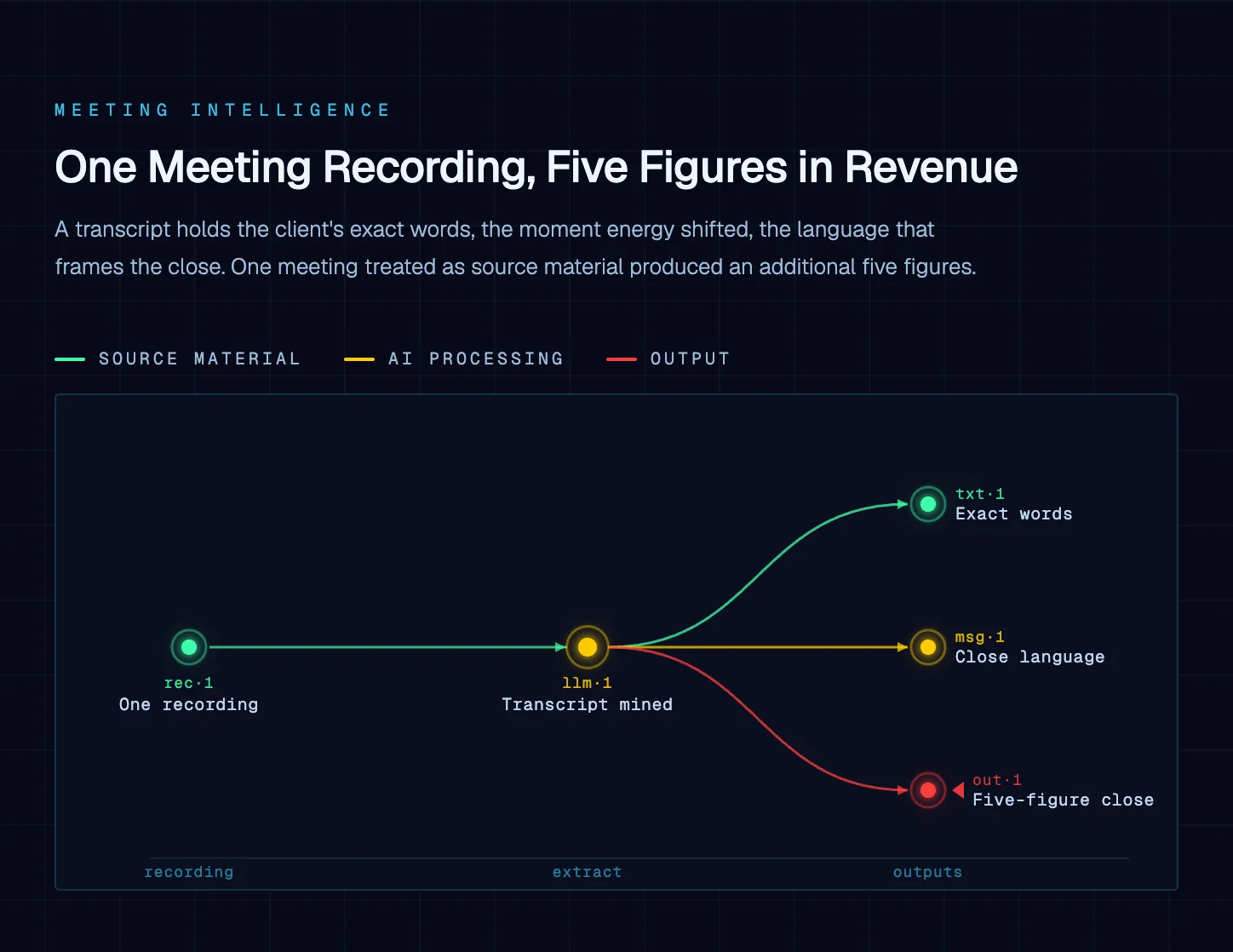
Here’s how a single recorded meeting was evaluated for that language – and how it generated an additional five figures.
What a Recording Captures That Nothing Else Does
Four things live in a meeting transcript that don’t exist anywhere else.
The client’s exact language for what they need. Their words, their framing, their specificity. When a client uses a particular phrase to describe what they’re looking for, that phrase is how they will explain it to the people they need to bring along. Using it back in the follow-up document removes a translation step that would otherwise cost you.
The objections they raised and then resolved. Clients often talk themselves through hesitation mid-conversation. That exchange captures both the concern and the reasoning that moved past it. Both belong in the proposal.
The approval chain they described. Clients who need to bring others along will describe that process in the meeting – who needs to be convinced, what those people care about, what framing will land with them. This is the information that makes a follow-up document fit the room it will actually be read in.
The moment the energy shifted. Every meaningful meeting has one. The transcript shows exactly where it happened and what caused it. In a sales process, that moment is the most valuable sentence in the entire document. It tells you what the client actually wants, in the language they used when they weren’t being careful about how they said it. A proposal built around that sentence lands differently than one built around your best guess.
Capture is the discipline that makes those four things available.
One Meeting, One Transcript, Five Additional Figures
A consultant had a meeting with an existing client – a multi-year program relationship, a renewal discussion for the coming year. During the conversation, the client said something that signaled an opening. A comment. The kind of thing that gets lost in notes because it doesn’t sound like a decision point when you hear it.
The meeting was recorded. The transcript went into an AI chat session alongside prepared material – prior program reports and documentation of how this client evaluated investments. The captured language met the surrounding context. That’s activation.
The session evaluated the transcript for exactly what the client had said in that moment – the specific words, the framing, the implication. It found the language. And the proposal was written around it.
The consultant built two options. Option A was the baseline continuation. Option B was an expanded investment – positioned around what the client had already signaled they cared about: protecting the value of what had already been built, and extending it rather than resetting it each year.
The language in Option B came directly from the transcript. The client read a proposal that described what he wanted in the words he had used to describe it. He didn’t need to translate it to the people who would review it. It was already framed the way he would frame it.
Option B was accepted. The additional investment it represented was five figures.
The consultant didn’t invent a new pitch for the upsell. They read the recording, found the moment, and wrote the proposal in the client’s own language. The work was extraction and reflection.
Three Things That Carry From This
The client signaled the opening. A transcript made it possible to go back, find the exact words, and build a proposal around them. Without the recording, that moment would have been a vague impression in someone’s notes – interesting, but not actionable.
A proposal written in the client’s language closes. The client reads it and it sounds like what they said they wanted – because it is. There’s no gap between what they described and what the document proposes. That alignment is what makes the second option feel like a natural progression.
One meeting produced two outcomes: the renewal and the expansion. Both came from the same transcript. Both were possible because the recording existed and was treated as source material. The multiplier is knowing where to look for the language that matters.
Related Reading
The follow-up email is often the first place meeting intelligence gets deployed – ChatGPT for emails covers how a transcript becomes the raw material for the message that closes.
When recordings accumulate over time, the pattern across them becomes as valuable as any single conversation – ChatGPT for data analysis shows what a collection of transcripts produces that no individual meeting could.
Transcripts need to be in a readable format before they work as source material – best file format for ChatGPT covers the preparation step that makes the difference.
Want to See This in Your Business?
One captured meeting compounds. The transcript becomes the proposal. The proposal becomes the precedent. The precedent shapes how the next renewal conversation is heard.
Book a 30-minute AI Discovery Call where we audit the meetings your business is already having – sales calls, client check-ins, renewal conversations – and show you what’s available in those recordings. No deck, no pitch, no obligation.