Activate
ChatGPT for Emails: Why the Output Sounds Wrong and How to Fix It
ChatGPT writes emails that don't sound like you – because it doesn't know you. Three examples showing what changes when your own language is in the session.
Email is the most voice-sensitive thing a business writes. Your reader doesn’t need to know what an AI is to know one wrote it – they feel the difference before they finish the first sentence. A warmth that isn’t warm. A tone that fits everyone and no one.
ChatGPT doesn’t know your voice, your history with the recipient, or what’s at stake in the message. Without that context, every email it produces sounds like the internet’s best guess at professional communication – competent, flat, and belonging to no one.
Three examples show what changes when the session includes what ChatGPT is missing.
The Voice Problem Is a Context Problem
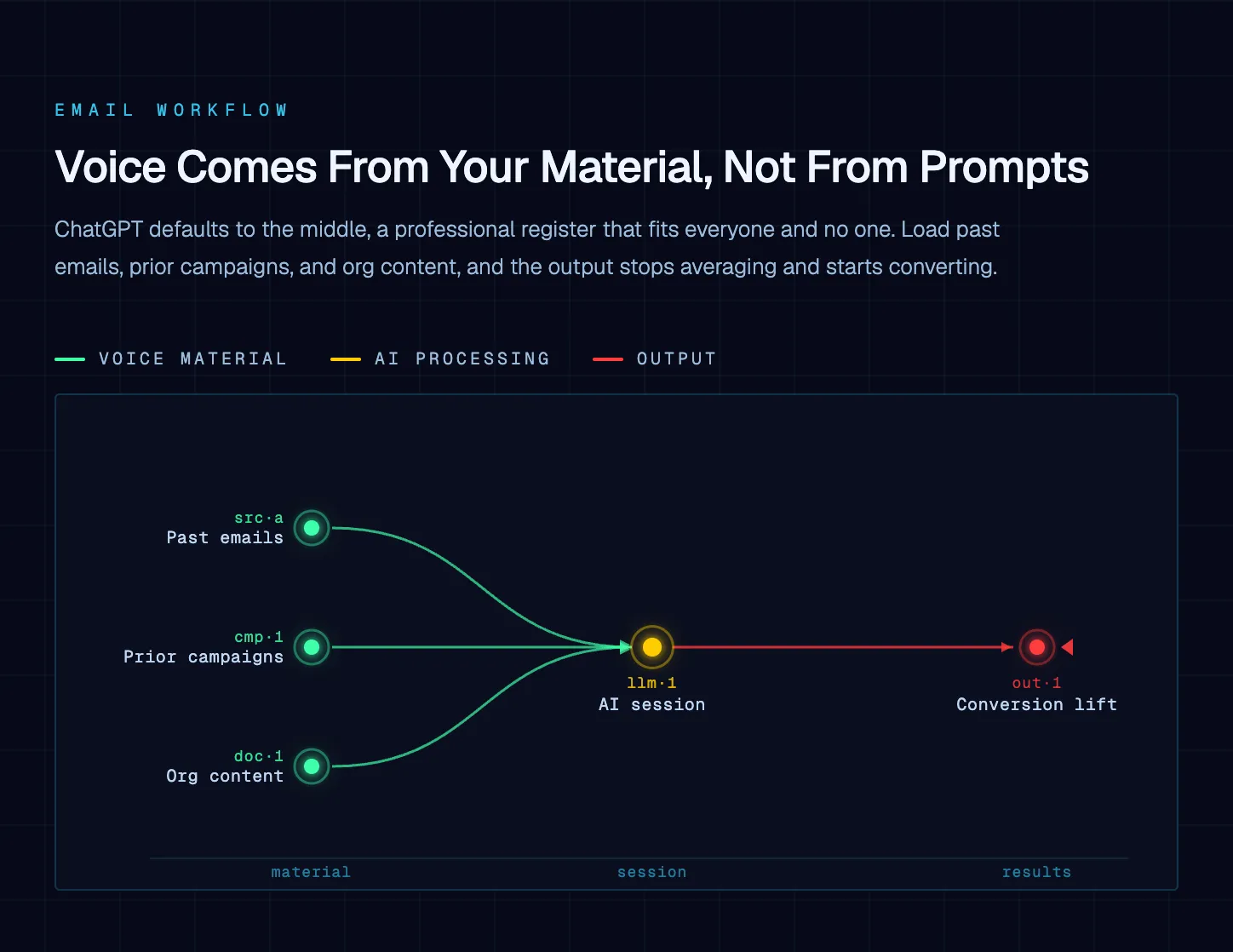
When you ask ChatGPT to write an email from scratch, you’re asking it to model your voice from nothing. It defaults to the middle – a smoothed-out professional register that offends nobody and sounds like nobody.
The fix is giving it examples of how you actually write.
Load past sent emails. Load previous campaigns. Load a document the recipient already has context on. Give the session the voice, the relationship, and the stakes – then ask it to write.
When the session has that material, the output stops averaging and starts approximating something specific. It still needs editing. But the starting point is right.
That’s activation: the language your business has already produced, loaded so the next email is built from your own material instead of the internet’s average.
Three Examples
Email Drip Campaign: Zero Meetings to Five
A business ran a cold outreach campaign to a professional audience – five emails in a sequence built to move a cold prospect from awareness to a conversation. Drip 1 produced zero responses and zero meetings.
The emails were competent. They described the program accurately. They were not generating results.
The session that produced the rewrite loaded prepared material the original hadn’t used: organizational voice guidelines built from years of existing content, a testimonial database with language from people who had completed the program, and a review of structural patterns known to convert in this market.
Drip 1 was rewritten to lead with a specific outcome from a named participant. Subject lines were cut to seven words or fewer. The body was shortened and made scannable. The call to action pointed directly to registration rather than routing through an additional page.
Drip 2 produced five meetings from the same list. Same offer. Different email – built from the organization’s own material rather than AI defaults.
Five meetings from a rewrite that took one session. The emails that followed were calibrated the same way, with different testimonials selected at each stage based on where the prospect was in the decision cycle.
Cold Outreach PR: Three Sentences, One Reply
A business identified a journalist whose published work directly addressed a problem the business had built a solution for. The article named the failure mode. The business had documented the alternative.
The session loaded the journalist’s article, the organization’s existing critique of the same problem, and the book they had written on the subject. A three-sentence cold email was drafted: a direct reference to the article by title, a one-sentence description of where the organization’s work picks up where the article left off, and an offer to share their documented approach – no pitch, no ask.
The journalist replied.
The email could only exist in that form because the session had access to both the journalist’s public work and the organization’s own material at the same time. The alignment between them was precise – the email named it because the session could see both sides.
Customer Relationships: The Email That Kept the Door Open
A community business had members whose annual subscriptions were expiring without renewal.
The session loaded one prior message that had successfully re-engaged a different disengaged member – a message that worked because it led with the relationship rather than the transaction. That message existed only because it had been captured – kept in a place the next session could find it. From that single example, the pattern was extracted: what made the language feel human, where it acknowledged the awkwardness around money without centering it, how it positioned the door as open rather than closing.
The resulting email didn’t try to save the subscription. It acknowledged the dynamic directly, without blame, and made clear the relationship wasn’t contingent on renewal.
Several recipients replied. Conversations continued. Some rejoined later.
One session. Letting those relationships end quietly, or sending a generic win-back sequence, had no upside.
What Carries Across All Three
The voice comes from your material, not from prompts. Asking ChatGPT to write in your voice without examples of your voice produces a generic approximation. Loading past emails, prior campaigns, or content the recipient already knows produces something specific. The difference is in what goes into the session, not how the prompt is written.
Every email type has a different conversion lever. The drip campaign lever was social proof from named participants. The PR outreach lever was precise intellectual alignment. The relationship email lever was honest acknowledgment. None of those levers are visible to ChatGPT without the organizational material that makes them specific to the situation.
Fewer words. Clearer ask. All three rewrites were shorter than their predecessors. Less room for the reader’s attention to wander before they reached the point.
Related Reading
The voice that makes email work has to come from somewhere – ChatGPT knowledge base covers how a documented archive of your own writing becomes the source material every email session draws from.
Drip campaign structure is one layer of a broader marketing system – ChatGPT for marketing shows how organizational voice applies across customer-facing content.
Meeting and call transcripts are often the source material for follow-up emails – AI meeting notes covers how recorded conversations become the raw material for the email that closes the deal.
Want to See This in Your Business?
Each email that lands becomes new context for the next one. The drip that converted becomes a reference. The reply that opened a door becomes a pattern. The body of work compounds.
Book a 30-minute AI Discovery Call where we audit the emails your business sends most often – campaigns, outreach, relationship touchpoints – and identify where your own organizational material can replace AI defaults. No deck, no pitch, no obligation.