Activate
ChatGPT for Marketing: Writing Websites and Landing Pages with AI
AI marketing copy sounds generic because ChatGPT doesn't know your business. Here's what a full website and landing page rewrite looks like when it does.
AI-generated marketing copy has a tell: it could belong to any business in any industry. The positioning is plausible. The language is professional. None of it is specific to you.
The absence of what the tool needs to do its job is the problem: your organizational data – your customer research, your competitive analysis, your existing voice, your documented positioning – loaded alongside the task.
When that material is in the session, the copy reflects what is specifically true about yours.
Loading it is activation.
Here’s what a complete website and landing page rewrite looks like when it’s grounded in organizational data – and what it took to get there.
What Generic Marketing AI Is Missing
ChatGPT does not know your customers’ language. It doesn’t know what your best clients said before they bought, what objection they raised mid-conversation, or what phrase they used to describe the problem you solved for them. Without that, it writes copy from assumptions – reasonable, middle-of-the-road assumptions that produce reasonable, middle-of-the-road copy.
It also doesn’t know your competitors. It can’t tell you which positioning territory they’ve already claimed, which words are overused in your category, or where the language gap is that your business could own. Without that, your copy sounds like theirs.
And it doesn’t know your voice. Give it examples of how you actually write, and it can match your rhythm, your directness, your way of landing a point. Without examples, it produces professional prose that belongs to no one.
The businesses that get strong marketing output from AI load those three things: customer language, competitive context, and their own existing content. What ChatGPT produces from an empty session and what it produces from a session loaded with all three are not comparable.
Website and Landing Page Copy: What a Full Rewrite Looks Like
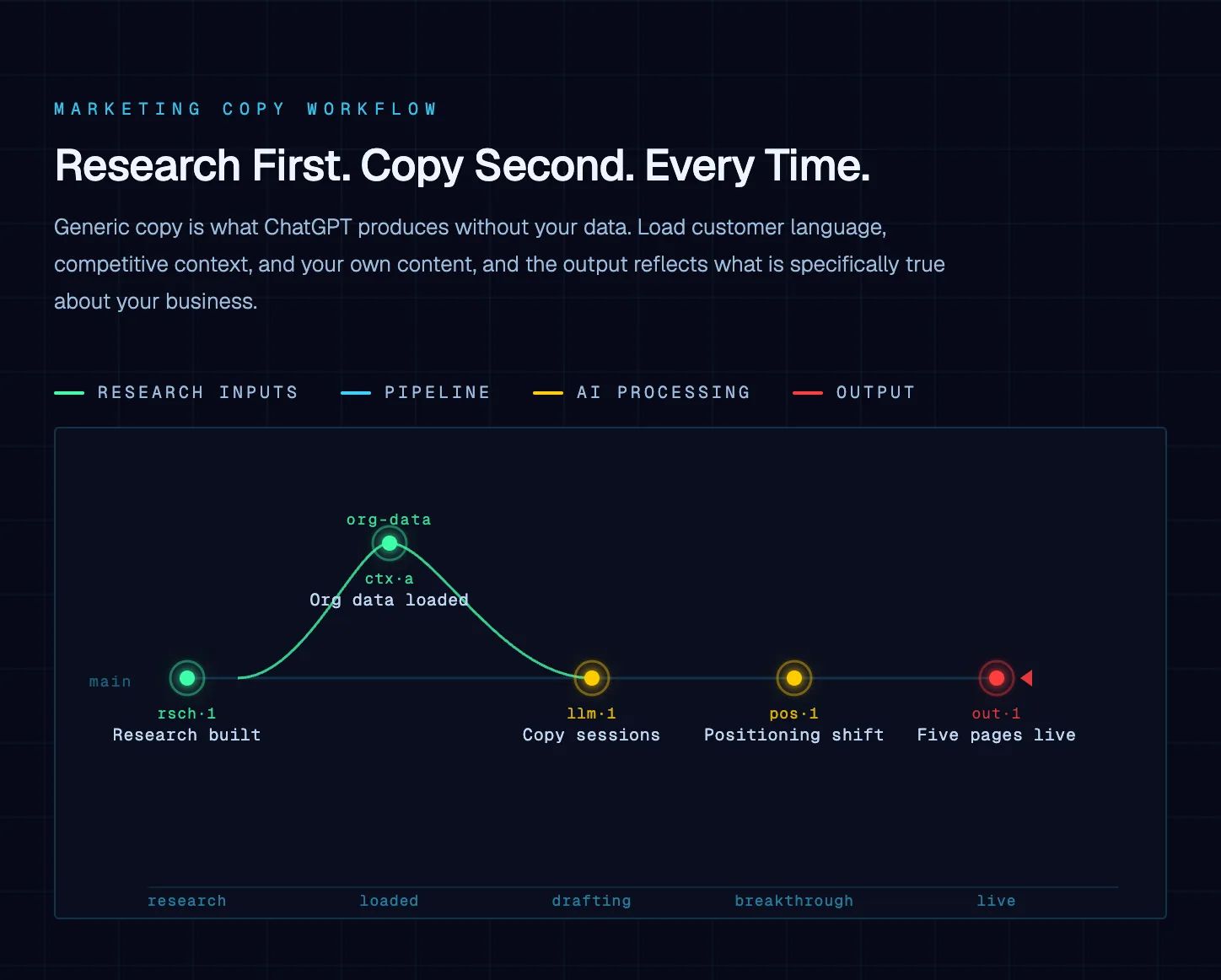
A consulting firm decided to rewrite its entire website. All of it. Homepage. Newsletter landing page. Book landing page. Post-purchase landing page. Community landing page. Five pages, each serving a different audience, each needing to convert.
The sessions that produced the copy were loaded with everything the organization had captured and built:
A competitive positioning synthesis covering six competitors – what they said, what language they had claimed, where the gaps were. An audience portrait built from 19 detailed profiles of their most engaged community members. A follower analysis covering 1,100+ people, showing which terms the audience used to describe themselves and which ones the organization was using or avoiding. A testimonial library from years of community feedback. The organization’s existing homepage and all prior marketing copy. Their complete messaging and language guidelines.
And their primary body of work: newsletters, a book and its glossary, and years of LinkedIn content. Not as background. As active source material in every session.
The process had a structure: prepare first, write second. The competitive analysis and audience research were completed before a single word of copy was drafted. That sequence mattered. When the copy sessions began, every decision had context. Word choices could be tested against what competitors had already claimed. Headlines could be evaluated against what the audience was actually reaching for. Positioning could be refined against what was genuinely unoccupied.
The homepage went through three complete versions before one was approved. Multiple sessions involved line-level editing – every sentence reviewed, options offered for specific phrases, individual word choices debated and resolved. The positioning itself shifted mid-process: a phrase the organization had relied on for months was identified as structurally wrong – it described one narrow output type and missed the majority of what the business actually produced. The new framing came from analyzing three of the organization’s own session logs against the claimed value proposition. The evidence was already there. The copy finally matched it.
Five finished pages. One consistent voice. A positioning statement the organization hadn’t been able to articulate before the sessions revealed it.
What the Rewrite Required
Research before copy – every time. The competitive analysis and audience research were completed before the first homepage draft. That sequence gave every copy decision a basis. Copy written after the research is written from evidence.
The Copy That Lands Uses the Customer’s Language. The audience analysis found specific terms the organization’s most engaged members were already using to describe themselves – terms the existing marketing copy hadn’t used. Those terms went into the new copy. Recognition is faster than explanation.
A positioning breakthrough requires both internal and external data in the same session. The phrase that had been wrong for months wasn’t caught by intuition. It was caught by loading session evidence alongside the competitive analysis – seeing what the organization actually produced sitting next to what competitors claimed, and noticing the gap. That kind of correction requires the organizational data to be in the room. It cannot happen from a prompt.
Related Reading
Customer language for marketing copy often lives in recordings before it lives anywhere else – AI meeting notes shows how customer conversations become the raw material for copy that converts.
Social media copy runs on the same organizational voice principles – ChatGPT for social media covers how a past-content archive becomes a style engine for posts and campaigns.
Email campaigns are where marketing copy gets tested against a real audience – ChatGPT for emails covers the before/after that shows what organizational material does to conversion.
Want to See This in Your Business?
The positioning statement that emerged became new context for every page that followed. The audience analysis became reference for the next campaign. The body of work compounds.
Book a 30-minute AI Discovery Call where we audit what your business has already built – customer research, competitive context, existing content – and show you what a grounded marketing session looks like. No deck, no pitch, no obligation.