Activate
ChatGPT for Social Media: Generic Posts Are a Voice Problem and a Source Problem
ChatGPT produces generic social media content because it doesn't know your voice or your customers' language. Two examples showing what changes when it does.
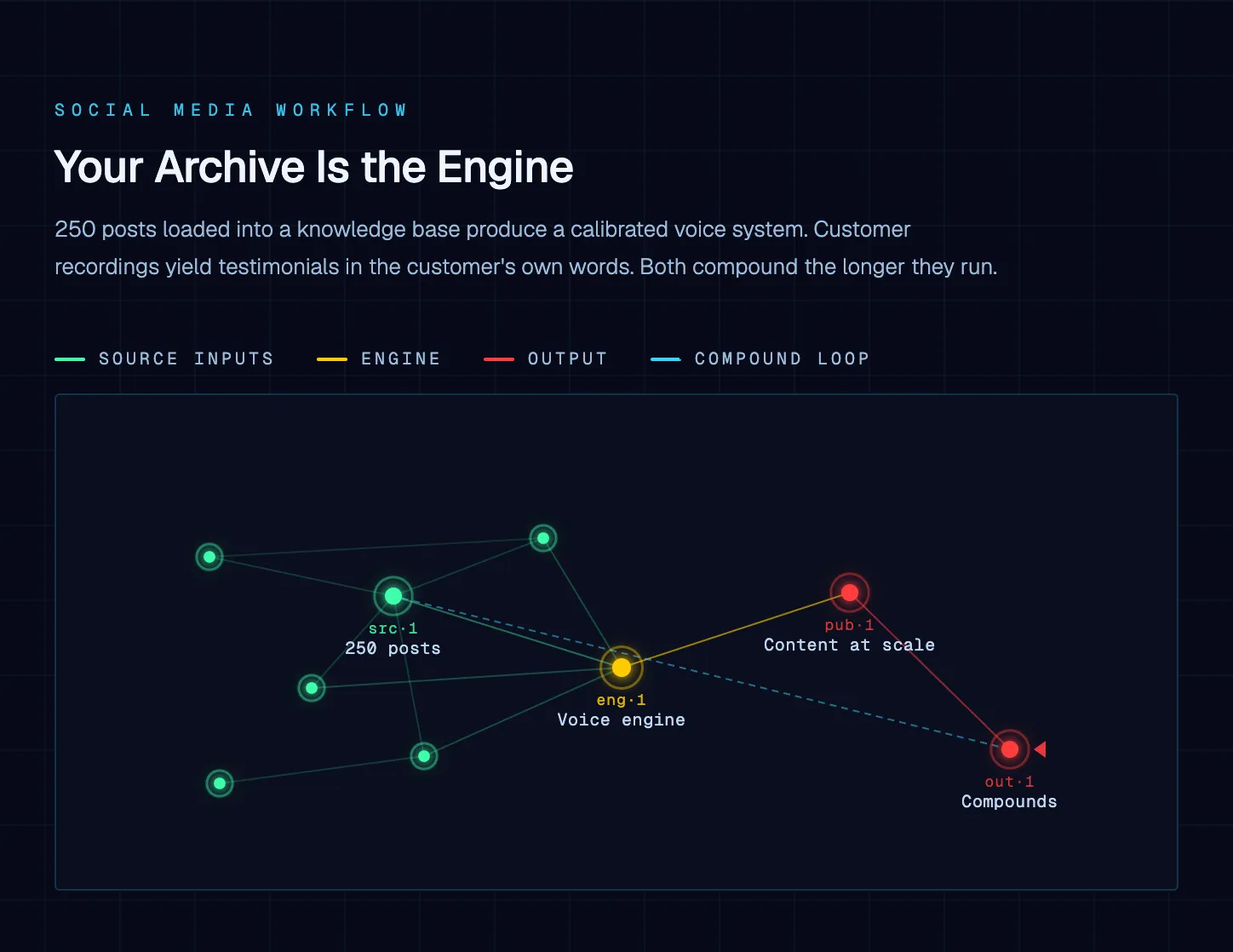
Social media AI produces generic posts for the same reason it produces generic emails, generic proposals, and generic copy of every kind: it doesn’t know your business.
It doesn’t know how you write, what rhythm your audience responds to, or what your customers say when they describe what you do for them. Without that, every post it produces sounds like every other post – competent, forgettable, and belonging to someone who doesn’t exist.
Two things fix this. The first is loading your own past content so AI can match your voice. The second is mining your customer conversations for the words they use to describe you. Both require organizational data you already have. Neither requires starting from scratch.
Both are activation – the body of work your business has already produced, loaded so the next post is built from your own material.
Why Voice Is the First Problem
The default social media AI output is average writing – the statistical center of how everyone in your category sounds. It will not offend anyone. It will not stop anyone from scrolling either.
Your voice is what stops the scroll. The specific rhythm. The way you open a thought. The kind of example you reach for. The length of sentence you use before you break it. These aren’t stylistic preferences – they are recognizable signals that tell your audience this particular piece came from you.
AI matches voice from examples. Load your actual past posts, in quantity, and the output stops averaging. It starts being something specific.
Two Examples
Content Marketing Writing Style Engine: 250 Posts, One Scale, Consistent Voice
A content creator built a LinkedIn archive – 250 posts over several years. The posts had a recognizable voice: specific opening moves, a particular rhythm, a way of landing a point. That voice had built an audience. But producing new content consistently, at that quality, took hours each time.
The solution was to load the archive.
All 250 posts went into a project knowledge base. From that corpus, a writing style system was prepared – a calibration engine with a 1–5 intensity scale: at level 1, a new piece of content would be lightly shaped toward the existing voice; at level 5, it would be fully transformed to match the signature style. The scale gave the creator precise control over how closely the output matched their voice.
The system was deployed across 14 sessions covering eight different content formats: LinkedIn posts, blog posts, event announcements, community replies, and more.
Two failure modes surfaced and were corrected through use. The first was over-explaining – endings that repeated the point already made rather than landing it and stopping. The second was misattribution – a session that credited a quote to the wrong speaker, caught before the post went live. Each correction improved the system. The operating model got better through iteration, not setup.
The result: a content creator who writes a draft and hands it to the engine. Any new topic, any format, any intensity level – the engine transforms the draft into a final version that matches their voice. The revision cycle shortened. The output quality held.
Testimonial Extraction: Mining Customer Language From Recordings
Social proof is the most powerful content in social media. A customer saying what you do for them, in their own words, stops a scroll in a way that any version of you saying it yourself cannot.
Getting that content is usually the problem. Asking customers to write a testimonial is a request most people intend to fulfill and never do. The result is a perpetual shortage of the one type of content that actually converts.
One organization had 10 recorded customer feedback calls – captured as a matter of practice. Instead of asking customers to write anything, they loaded the transcripts into an AI chat session and mined them for quotes.
The session read each transcript, identified the moments where customers described their experience in specific, quotable language, assessed which statements had the most credibility and specificity, and refined the raw conversational language into tight, usable copy. Not every call produced a testimonial – some were too operational, too brief, or too generic to yield anything worth using. The ones that did produced quotes that went directly onto the website and into social media posts.
The ROI was immediate. No follow-up emails asking customers to write something. No waiting weeks for a response that never came. No badgering clients or customers for testimonials. The language was already there, in recordings the organization had made. The session retrieved it.
The quotes were stronger than anything customers would have written themselves. Written testimonials tend toward polished and professional. Spoken feedback, captured in conversation, is specific, concrete, and carries emotional weight – because the customer was talking about their experience.
What Carries Across Both Examples
Your past content is the generator. It’s the source the engine draws from every time you use it. Load your own archive and the output stops averaging. 250 posts is a sufficient corpus. The more you provide, the more specific the calibration.
Your customers’ words outperform yours in social proof. A customer describing what you do for them – in their own language, from a real conversation – carries weight that self-description cannot. Those words exist in recordings you have already made. They require extraction.
Both sources compound over time. The writing style engine improves as more corrections are made and more formats are deployed. The testimonial archive grows as more calls are recorded and mined. Neither is a one-time setup. Both produce more value the longer they run.
Related Reading
The archive that grounds a writing style engine needs to be in a format AI can read – best file format for ChatGPT covers the conversion step that matters before any knowledge base session starts.
Customer recordings don’t stop being useful after the testimonials are extracted – AI meeting notes covers how the same transcripts that produce social proof can drive sales outcomes.
The same organizational voice that makes social media work applies across every customer-facing surface – ChatGPT for marketing shows how a documented voice system scales from posts to full campaigns.
Want to See This in Your Business?
Book a 30-minute AI Discovery Call where we audit the content your business has already produced – past posts, customer recordings, existing archives – and identify what’s ready to become a voice system or a source of customer language. No deck, no pitch, no obligation.