Audit
AI Business Audit: The Step That Happens Before the First Prompt
AI produces exceptional work from your body of work – but first you have to assess what assets your business has produced. Here's the audit that made an entire site of cluster pages possible.
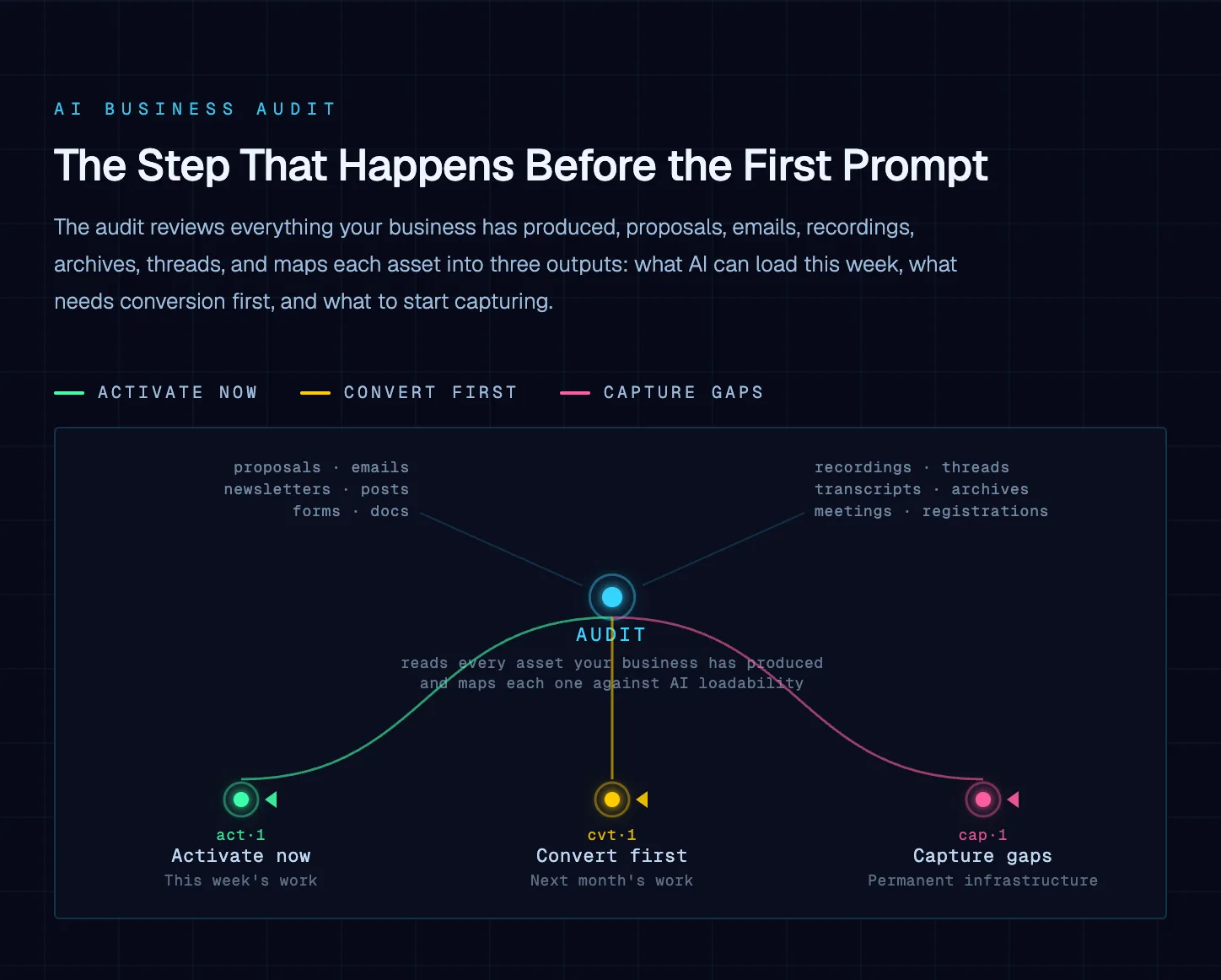
AI produces exceptional work from your body of work. Before any of that becomes possible, you must first assess what assets your business has produced.
The default move is to open an AI session, type a question, and take what comes back. The session has the question. It doesn’t have the business. The proposal request returns the internet’s average proposal. The marketing copy returns the internet’s average marketing copy. Every output averages because every prompt arrives empty.
The fix starts upstream. An audit of your body of work – what you have, where it lives, what’s loadable now, what needs conversion, what’s missing – is the step that gives the next session something to work from. The cluster pages on this site exist because the audit ran first.
Why the Audit Comes First
AI works from the material you give it. If you don’t know what you have, you can’t load it. If you can’t load it, the output averages.
Each file your business has produced has a second life waiting. The proposal closed a deal. The newsletter shipped to subscribers. The workshop happened on a Tuesday. The audit looks at what each one can do now: as context an AI session loads, as source material for the next proposal, as raw material for the next ten newsletters.
It reveals three things at once. What is ready to activate. What needs preparation – conversion to formats AI can read at scale. What isn’t being captured today that should be.
Activation is this week’s work. Preparation is next month’s. Capture is permanent infrastructure.
One Example: The Audit Behind This Site
Once I understood that AI produces exceptional work from a body of work, I started evaluating what assets I had.
I went through Google Drive to identify which proposals had won, which had lost, and which spreadsheets were collecting the most data through form submissions. I started to see how my in-person lectures differed from my online ones – online lectures produced transcripts, video, and audio, which opened entirely new possibilities for downstream work.
I looked through my emails to find which ones I had written were most effective and had the greatest return. I looked through my newsletters to find which had the highest open rate and which were eliciting the strongest feedback from readers. I looked at my LinkedIn posts to find which were getting the most engagement and why.
I read Slack threads for sustained conversations on specific topics. The inventory expanded: web pages, drip campaigns, transcripts from recorded workshops, transcripts from recorded Google Meet calls and in-person meetings, the best blog posts, the LinkedIn archive, the newsletter archive, the book and its glossary, testimonials from clients and newsletter subscribers and book buyers, and the daily, weekly, and client meetings that turned out to be the richest source material of all.
The three primary drivers were the newsletter archive, the book, and the client meetings.
One surprise: I had overlooked the registrations to my online workshops and programs. The forms asked open-ended questions, and those answers held qualitative material that informed how to structure future workshops. The category appeared because the audit ran.
What the Audit Produced
The audit produced a list of materials that needed conversion to Markdown, text, or CSV files – to minimize project size and load as much context as possible. The first attempts at loading PDFs directly hit limits fast. The audit, paired with the conversion work it required, made the difference between projects that held a few documents and projects that held the body of work.
It also produced a map of capture gaps. Once I saw the inventory, capture potentialities came into focus. Meetings that weren’t being recorded. Conversations that ended without notes. Workshop registrations that asked open-ended questions but never harvested the answers. The audit inventoried what existed and revealed what should be captured going forward.
Three Things That Carry From This
The audit reveals three things at once. What is loadable now, what needs preparation, what to capture going forward. The first determines what you can do this week. The second determines what you can do next month. The third determines what you can do every week after.
You find what you didn’t know was there. The workshop registrations were a surprise. The Slack threads were a surprise. The internal meeting recordings were a surprise. Discovery-first finds material that creates categories no pre-built list would predict.
Without the audit, you work from a fraction of what’s possible. Every cluster page on this site exists because something specific from the audit unlocked it. The proposals page exists because the audit found the winning and losing proposals. The meeting notes page exists because the audit revealed the capture gap. The knowledge base page exists because the audit produced the conversion list. Without the audit, those pages would belong to any business in any industry.
Related Reading
The conversion list the audit produced has a specific shape – best file format for ChatGPT covers the format decisions that determine whether your archive becomes loadable or stays stuck.
The capture gaps the audit reveals usually start with meetings – AI meeting notes covers the upstream discipline that turns conversations into source material.
An audited and converted archive becomes infrastructure – ChatGPT knowledge base shows what an organized body of work produces when AI can read across all of it at once.
Want to See This in Your Business?
Book a 30-minute AI Discovery Call where we audit one slice of your body of work – the proposals, the recordings, the archives, the threads – and surface what’s loadable now, what’s worth converting next, and where the capture gaps are. No deck, no pitch, no obligation.