Activate
AI Prompts for Business: Why Generic Prompts Produce Generic Results
A generic prompt produces generic output. A purpose-built prompt grounded in your organizational data produces something only your business could generate. Three examples.
A prompt is the question you ask AI. The answer you get back is only as specific as what the prompt has to work with.
A generic prompt – “write a blog post about AI for small businesses” – works from everything AI was trained on. The output is competent, general, and interchangeable with what any other business in the category would produce asking the same question.
A purpose-built prompt references your specific data, your documented strategy, your organizational context. It asks AI to produce something that only exists because your material is in the session. The output is specific because the prompt was designed around what is specifically true about your business.
What Makes a Prompt Purpose-Built
The difference is the source material the prompt is prepared to draw from.
A purpose-built prompt asks AI to produce something from your training data – your past content, your customer research, your documented strategy, your competitive analysis. When that material is in the session and the prompt is designed to pull from it, the output cannot be replicated by any other business with the same prompt. The source material is what makes it specific.
Purpose-built prompts also improve over time. As more organizational material is documented and loaded, the prompt produces more refined output. As the prompt is used and refined through use, it improves. A purpose-built prompt is infrastructure.
That’s activation – the body of work and the engine working together, every time the prompt runs.
Three Examples
Building the Blog Inventory Workflow: One Prompt, 113 Structured Files
A business had accumulated a backlog of AI working sessions – hundreds of sessions documenting real work done for clients. Each one captured during the normal course of client work. That backlog was potential content: case studies, methodology demonstrations, use cases, proof of work. Before any of it could become a website, it needed to be inventoried.
Instead of reading through every session manually – a task that would have taken weeks – a single extraction prompt was built from the business’s existing SEO research, content strategy, cluster page architecture, and keyword inventory. Those documents defined exactly what information needed to be extracted from each session to determine whether it was a candidate for a specific type of page on the website.
The prompt was applied to the session backlog. It produced 113 structured inventory files – each one in the same format, each one directly usable for content planning. The prompt ran in hours. The manual alternative would have taken weeks.
The prompt runs against every future session added to the backlog. The content inventory grows automatically. What was a one-time extraction became a permanent workflow.
Audience Intelligence for Copywriting: Three Prompts That Built a Messaging System
A consulting firm needed to rewrite its website. Before any copy could be written, it needed to understand its audience precisely – not in general terms, but in the specific language its most engaged customers used, the positioning gaps in its competitive landscape, and the segments in its broader audience that were arriving without being explicitly targeted.
Three prompts were built from the firm’s existing organizational data: a competitor analysis prompt, an audience profiling prompt, and a follower segmentation prompt. Each prompt was designed to run against a specific type of source material – competitor documents, audience profiles, raw follower data – and produce a structured output that answered a specific strategic question.
Together, the three prompts produced a messaging system. The competitor analysis identified unoccupied positioning territory. The audience profiles revealed the exact language the firm’s best customers used to describe themselves – language that hadn’t appeared in the existing marketing. The follower segmentation identified audience segments arriving organically that no existing content had explicitly addressed.
The prompts were documented and saved. The competitor prompt runs again whenever a new competitor enters the market. The audience prompt runs whenever new member profiles are available. The follower prompt runs with each new export. Each time, it produces intelligence that feeds directly into copy decisions.
AI Website Copy for Outbound Sales: A Seven-Section Prospect Intelligence Framework
A business was conducting outbound sales to a specific type of institutional client. Before each prospect conversation, the team needed intelligence: the organization’s stated priorities, the decision-maker’s background, the language the institution used publicly, the competitive landscape they operated in, and the most relevant framing for the conversation.
A research prompt was built with seven sections, each targeting a specific type of intelligence: organizational priorities, decision-maker profile, institutional language patterns, recent announcements, competitive context, likely objections, and alignment between the prospect and the firm. The prompt was designed to run in a research session before any prospect call.
The output was a structured briefing that took one session to produce and typically would have taken three to four hours to compile manually. The briefing gave the sales team everything they needed to walk into the conversation knowing exactly what to reference, what language to use, and where the alignment between the prospect’s priorities and the firm’s offer was strongest.
The prompt was reusable. Every new prospect ran through the same framework. Each briefing was different because each organization was different – but the structure, the quality, and the preparation time were consistent.
What All Three Share
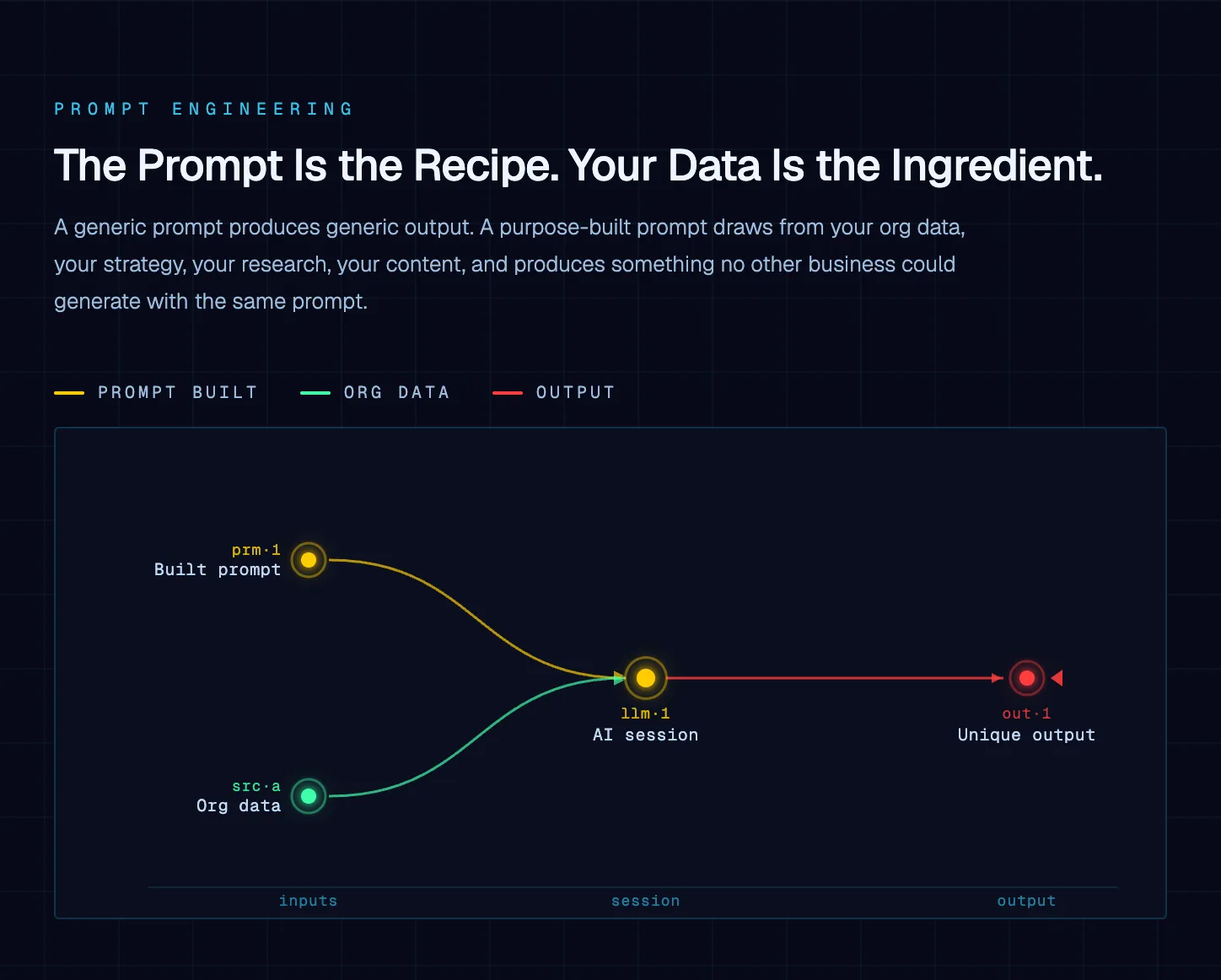
The prompt is the recipe. The organizational data is the ingredient. All three prompts produced output that could not be replicated by another business with the same prompt, because the source material loaded alongside them was specific to this organization. Load the source material and the prompts produce intelligence.
A purpose-built prompt is infrastructure. All three prompts were designed to run again. The extraction prompt runs on every new session. The audience intelligence prompts run on new data. The prospect research prompt runs before every call. A prompt designed to be reused is a system.
Prompts improve through use. Each time a purpose-built prompt is run and the output is evaluated, there is an opportunity to refine it. A prompt used fifty times is more precise than the same prompt used once. That improvement compounds with the organizational data – more data, better-calibrated prompt, more specific output.
Related Reading
The source material that makes a prompt purpose-built lives in the knowledge base – ChatGPT knowledge base covers how an organized archive is what gives a prompt something specific to work from.
Audience intelligence prompts feed directly into marketing copy decisions – ChatGPT for marketing shows how the output of an audience analysis session becomes the brief for a website rewrite.
Prospect research prompts are part of the same workflow as proposal writing – ChatGPT for consultants covers how pre-call intelligence shapes the documents that close.
Want to See This in Your Business?
Book a 30-minute AI Discovery Call where we audit the recurring research and analysis tasks in your business – and identify which ones are ready to become purpose-built prompts. No deck, no pitch, no obligation.