Activate
ChatGPT for Content Creation: Your Archive Is a Content Engine – Using AI to Repurpose Your Body of Work
Every presentation, recording, and report your business has produced is a content asset waiting to multiply across every channel. Here's what that looks like when AI is doing the repurposing.
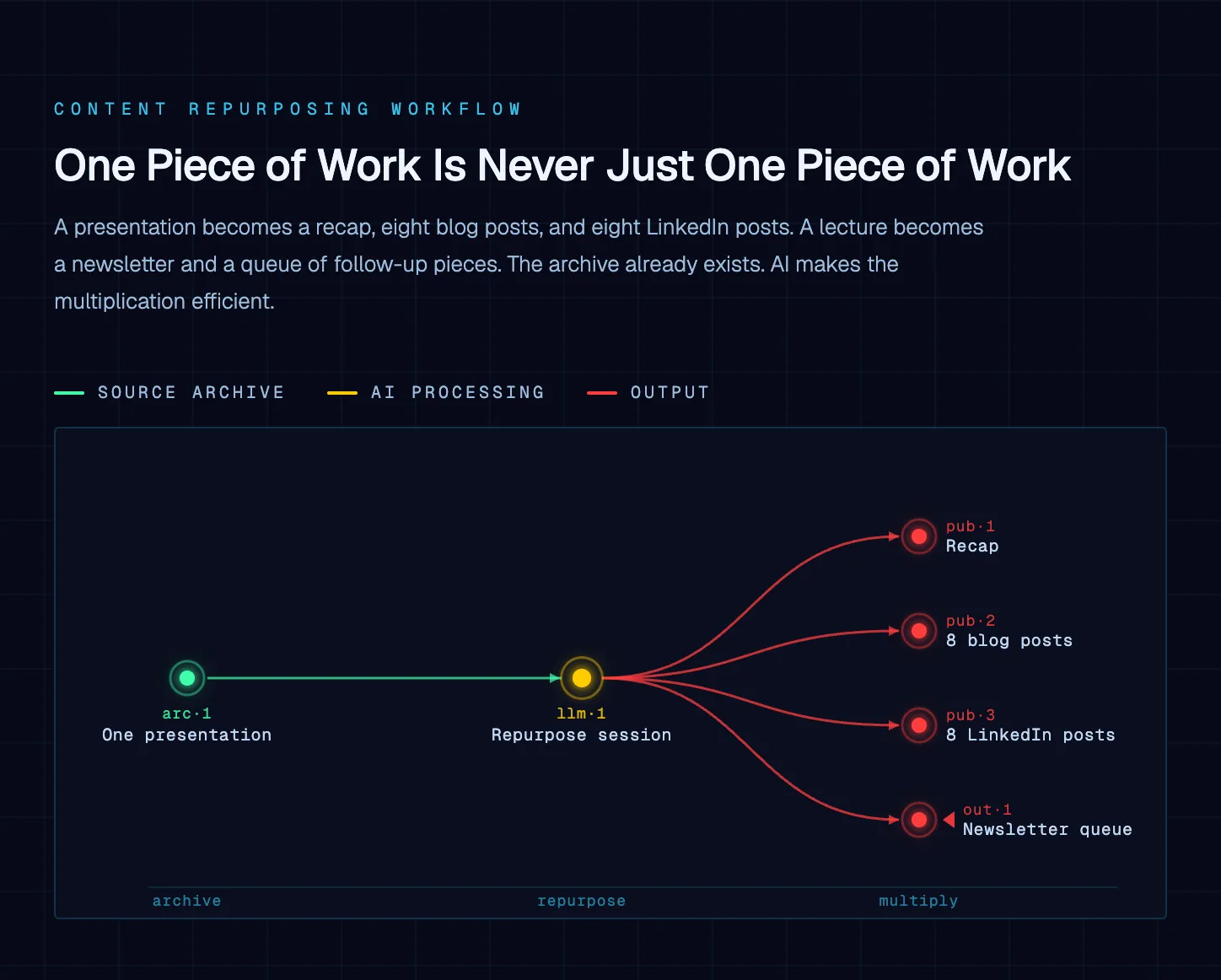
Every business has a body of work. Most of it is sitting in a folder somewhere, doing nothing.
Presentations delivered once and archived. Recorded sessions watched live and never revisited. Reports written for one client that contain insights every future client needs to hear. The work happened. The content opportunity never followed.
Repurposing is the practice of taking what you’ve already produced and turning it into content for every channel where your audience finds you. A presentation becomes a recap. The recap becomes eight blog posts. Each blog post becomes a LinkedIn post. One piece of work – already done, already paid for – multiplies across every surface without requiring the original effort again.
AI makes that multiplication efficient. When the source material is in the session, the repurposing happens at a scale no individual could sustain manually.
That’s activation – the captured work meeting the engine that multiplies it.
The Repurposing Gap
The question worth asking isn’t what to create this week. It’s what you’ve already produced that hasn’t been repurposed yet.
Start with the audit: what already exists, and which channels it hasn’t reached.
A single recorded presentation contains the raw material for a structured recap, a series of blog posts, a set of social posts, a quote pull, and a reference guide. A report written for one client contains insights that belong in your marketing, your pitch materials, and your email campaigns. A collection of recorded sessions contains the case studies, methodology demonstrations, and proof-of-work that your website is missing.
It requires repurposing – taking what already exists and producing it in the formats where your audience actually finds it. AI amplifies the work you’ve already done.
Two Examples
Presentations: From One Live Session to Eight Blog Posts to Eight LinkedIn Posts
A consulting firm held many live presentations – recorded sessions covering frameworks, methodologies, and practical applications for their community. Not every member could attend every session. For those who missed it, the recording existed. But a 90-minute recording and a readable, navigable recap are not the same asset.
A repurposing workflow was built. Each presentation transcript went into an AI session with a defined output structure: eight sections, each capturing a distinct insight from the session, with a header, a summary, and supporting detail. Three presentations ran through the workflow in a single session. Three structured recaps came out, each ready to publish.
That was the first level of repurposing. The second level turned each recap into eight standalone blog posts – one per section, each expanded with context and a practical application. The third level turned each blog post into a LinkedIn post, compressed to the format and rhythm of the platform.
One presentation. One session. Eight blog posts. Eight LinkedIn posts. Three full content cycles across three channels – all from work that had already been done.
The compound effect runs forward too. Every new presentation the firm holds now automatically enters the same pipeline. The archive that had been sitting as recordings became active across every channel the firm uses.
Lectures Repurposed as Newsletters: Three Recordings, Three Publications
A second organization had a library of recorded lectures – each built around a slide deck, each substantive enough to stand alone as a publication. The challenge: a lecture designed to be spoken alongside visuals doesn’t work as a standalone document. Slide decks are designed to accompany a voice. Without it, they’re fragments.
The repurposing pipeline worked in two passes. First, the full transcript was read to understand the arc of the argument – what was established, how it built, where it landed. Second, the slide deck was reviewed slide by slide, matching each visual to the moment in the transcript it was illustrating.
The output: a newsletter draft with the lecture’s argument written as prose, with each slide image matched to the exact moment in the text it was illustrating. Drop in the images and it’s done.
Three lectures produced three newsletter drafts ranging from 1,750 to 3,500 words.
Extra material – Q&A, side discussions, extended examples that didn’t fit the newsletter – was preserved separately as notes flagged for future pieces. One recording became a newsletter, a notes file, and a queue of follow-up content. Eight more lectures were queued immediately.
What Both Examples Demonstrate
Every Piece of Work Contains Multiple Outputs. A presentation is a recap, a blog series, a social campaign, and a reference guide waiting to be made. A lecture is a newsletter, a quote library, and a series of shorter pieces. The original work is the seed. Repurposing is the multiplication. AI is what makes it efficient enough to actually happen.
Repurposing requires complete source material. Both pipelines needed complete transcripts, full slide decks, and defined output formats. The AI produced accurately because what it was given was complete. Where source material is thin, so is the output. The amplification is proportional to what you bring to it.
A defined output structure turns repurposing into a pipeline. Both examples prepared the output format before running any content through it. That structure is what turns a one-time experiment into a recurring system. With it, the tenth piece costs less than the first.
Related Reading
The format your source material is in before the session starts affects what the repurposing produces – best file format for ChatGPT covers the preparation step that makes transcripts and documents work efficiently.
A documented voice archive keeps repurposed content consistent across channels – ChatGPT for social media covers how a past-content corpus becomes the style system that holds the voice together as it multiplies.
The same repurposing logic applies to marketing copy – ChatGPT for marketing shows how existing organizational material becomes website and landing page copy without starting from zero.
Want to See This in Your Business?
Book a 30-minute AI Discovery Call where we audit the presentations, recordings, and existing work your business has already produced – and map what a repurposing pipeline looks like across your channels. No deck, no pitch, no obligation.