Activate
ChatGPT for Sales: Writing Proposals From the Client's Own Words
The proposals that close aren't written from what you assume the client needs. They're written from what the client already said. Here's how AI surfaces that language – and what it produces in revenue.
Every sales conversation contains a proposal – the language the client uses when they describe what they want, what they’re worried about, and what would make them say yes.
That language gets heard and then ignored. Sellers write a proposal in their own words. The client receives a document that is accurate but unfamiliar – and has to do the work of connecting what they said to what’s on the page.
A client who reads a proposal and recognizes their own wants and needs reflected back to them doesn’t need to evaluate. They already agree – because the document is speaking their language, addressing their specific concern, built around what they told you they needed. That recognition is what converts a proposal from a document into a close.
AI makes this possible by mining the client’s language from the conversations that already happened and making it the basis of what you send.
The Gap Most Proposals Leave Open
A proposal written from the client’s perspective answers a specific question: what did they tell us they needed, and how does what we offer speak directly to that?
It reflects the client’s own articulation of their problem back to them, with the solution positioned inside it. A client reading that proposal sees themselves. Their priorities. Their concerns. Their logic. The closer that alignment, the faster the close – and the higher the investment they’re willing to approve.
Getting there requires the client’s language. That language lives in the call transcript, the email thread, the comment made at the end of a meeting. Capture creates the material. Preparation makes it usable. Loading it is activation. When it’s in the session – analyzed and mined from a recording – AI finds it immediately, and the proposal gets built around what the client actually said rather than what the seller assumed they meant.
One Renewal Conversation That Became an Upsell
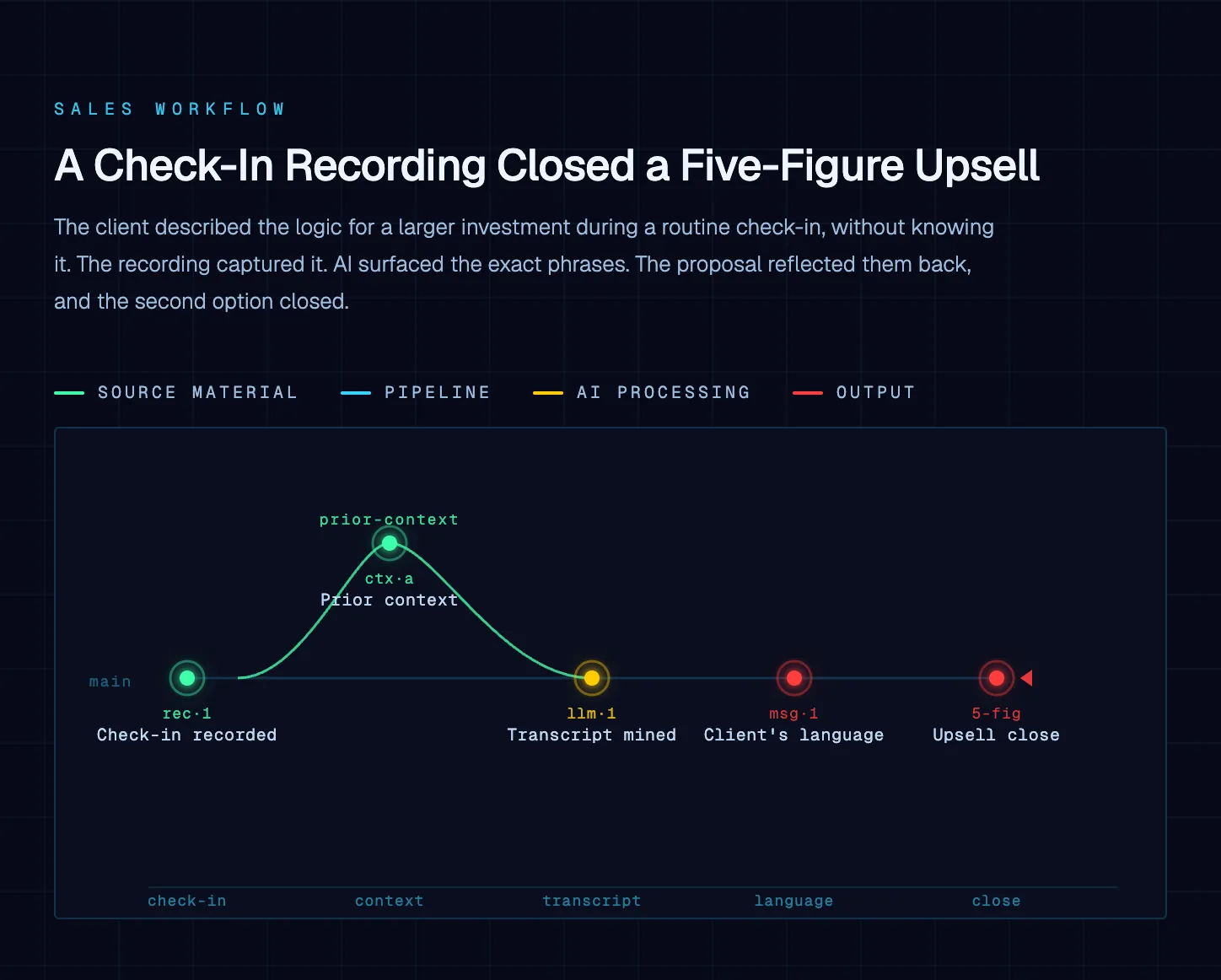
A consulting firm was in a renewal conversation with an established client. The relationship was solid, the program had performed well, and both sides expected continuation at the current investment level. The meeting was a check-in.
During the conversation, the client talked about the following year with a specific concern: the program had produced results, but those results were fragile. The infrastructure built – the participants trained, the community created, the institutional knowledge accumulated – could deteriorate without active investment to sustain it. Starting over the following year would cost more than continuing now. He was describing the logic for a budget increase.
The conversation was recorded. The transcript was analyzed and mined by AI. The specific phrases appeared immediately – verbatim. The exact language the client had used to describe the risk of not investing, the value of what existed, the logic of continuity over reset.
Two investment options were built from that language. The baseline continued the program at the current level. The second option – the upsell – was positioned as the investment required to protect what had already been built. Every section used the client’s framing. The risk he had described. The logic he had laid out. The language he had used without knowing it was becoming a proposal.
He approved the second option.
The additional revenue from that single upgrade was five figures. It came from a check-in meeting that had not been scheduled as a sales conversation. It was reflected back from what the client had said – because the recording existed, the transcript was mined, and the proposal was built from the right source material.
What This Means for Revenue
Every recorded conversation is a potential proposal brief. A client describing their situation, their concerns, and their priorities is handing you the language for a document they will recognize when they read it. The more of those conversations that get recorded and analyzed, the more proposals get written in the client’s language – and the higher the close rate on each one. The body of work compounds across every deal.
A proposal that reflects the client’s wants and needs back to them removes the friction that kills deals. Every degree of distance between what the client expressed and what the proposal says is a reason not to sign. A proposal built from the client’s own language has no translation step, no interpretation gap, no moment where the client has to wonder whether the consultant understood what they said. That removal of friction is revenue.
The upsell lives in the client’s reasoning. In this example, the higher investment option closed because it was structured around logic the client had already expressed – before the proposal existed. They showed the client that what they had described wanting was available at a higher investment level. The client had already done the reasoning. The proposal confirmed it.
Related Reading
The transcript that becomes the proposal brief starts with a recorded meeting – AI meeting notes covers how the recording becomes source material and what to look for when you use it.
The same client-language principle applies to email follow-ups – ChatGPT for emails covers how a transcript becomes the message that moves the deal forward after the call.
When the proposal has to clear multiple stakeholders, each section needs to reflect the priorities of a different reader – ChatGPT for consultants covers how research on the approval chain shapes the documents that close.
Want to See This in Your Business?
Book a 30-minute AI Discovery Call where we audit the sales conversations your business is already having – and show you what mining those transcripts for the client’s language changes about what you send. No deck, no pitch, no obligation.