Activate
ChatGPT for Small Business: Building a Business Foundation With AI
Starting a new product or service means building a business model, competitive analysis, and go-to-market strategy from scratch. AI can do all of it – when your thinking is in the session.
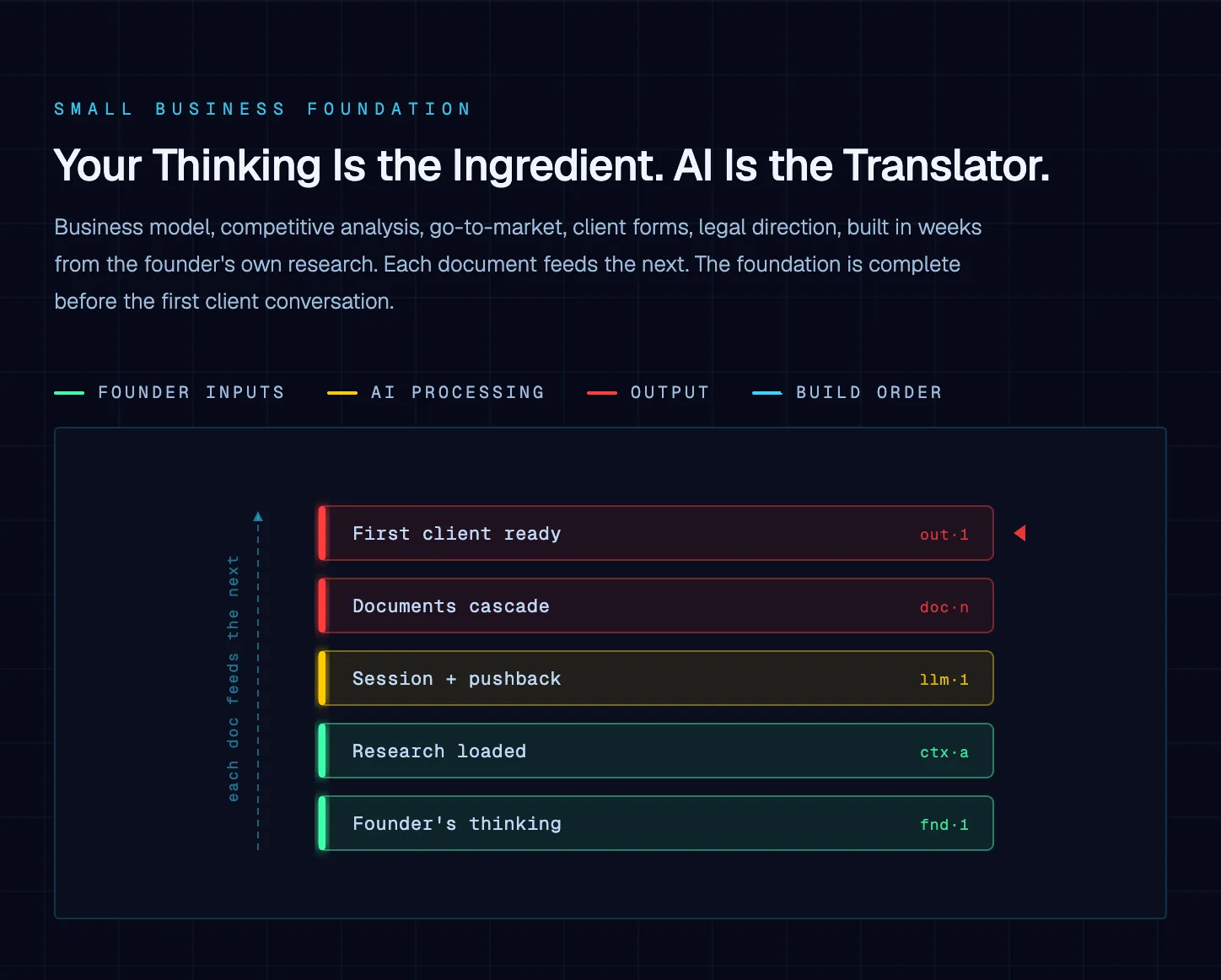
Starting something new – a business, a product, a service line – requires building a foundation before anything can be sold. A business model. A competitive analysis. A go-to-market strategy. Pricing. Client intake forms. Legal agreements. The work is substantial, and most of it needs to happen before the first client conversation.
AI can do all of that work – when the early-stage research, outlined concepts, and initial directions are in the session. It translates them into structured documents at a speed and scale that no individual could match working alone.
That’s activation – the founder’s thinking loaded as live source material before the first document is drafted.
The result is a specific set of documents built from the founder’s actual understanding of the problem, the customer, and the market. Documents that use the founder’s language, reflect their specific competitive observations, and position the business around the gap they’ve identified rather than around the generic description of a category.
What AI Needs to Build a Business Foundation
AI organizes, structures, and extends the strategy a founder already has. Load the session with the founder’s own research – the raw notes, the problem statement in their words, the customer description they’ve built through in-person and online conversations, comments in LinkedIn threads, and direct observation, the pricing instincts, the competitive observations – and the output is specific rather than average.
The process also requires the founder to push back. The first draft of any strategic document produced through AI is a starting point. Where it generalizes too much, the founder corrects it. Where it misses a nuance, the founder adds it. Where the language doesn’t match how the business actually positions itself, the founder rewrites it. That back-and-forth is the approach. Using AI as a thought partner to expose blind spots, challenge assumptions, and help articulate a fuzzy vision into specific, actionable deliverables.
One Example: Business Foundation for a New Consulting Practice
A consultant was moving a concept from early-stage idea to something ready for client validation. The concept had been developed over months of thinking, but the thinking existed as raw notes and working documents, not as structured business materials. The thinking had been captured, but not yet prepared. To test the concept with potential clients, advisors, and partners, the foundation needed to be built and clarified based on research and data.
The session was loaded with everything the consultant had: a working document covering the full business concept, the problem statement, target market thinking, revenue model ideas, marketing angles, open questions, and existing reference materials. Prior research on the market was loaded alongside it.
From that material, the session produced a complete business model canvas – ten files covering customer segments, value propositions, channels, customer relationships, revenue streams, key resources, activities, partnerships, and cost structure. Each file was written to reflect the consultant’s specific understanding of their business, not a generic template filled in with placeholder language.
A competitive analysis followed: a landscape overview, a detailed walk-through of five competitor categories, direct competitor profiles, an analysis of a major market entrant and what it meant for positioning, a gaps analysis identifying five areas the market hadn’t addressed, a pricing reality check against competitive benchmarks, and a file capturing what to adopt from competitors and what to avoid.
Go-to-market materials came next: a full channel strategy, outreach letter copy for two distinct versions of the same audience, follow-up email sequences, a partner one-pager, a workshop repositioning document, and a 14-month marketing calendar.
Client-facing forms were built: a discovery intake form, a client onboarding form, and an interest capture form with an automated follow-up email.
Legal direction was documented: a review of existing agreements, an assessment of what was inappropriate for this type of engagement, and a recommendation for the right legal path forward.
Every major decision in the engagement was locked as it was made: domain, website stack, email, pricing structure, geographic scope, channel sequence, and client qualification criteria.
The full foundation – across business model, competitive analysis, go-to-market, and operational setup – was produced in a single extended engagement. Every document reflected the consultant’s specific thinking, corrected and refined through multiple rounds of pushback. The result was a foundation specific enough to take into the first client conversation.
What This Demonstrates for Small Business Owners
Your thinking is the ingredient. AI is the translator. The quality of what came out of this engagement was determined by the quality of what went in. The founder’s specific experience, specific customer observations, and specific competitive instincts were what made the output useful. AI organized and structured that thinking into documents. It did not replace it.
Pushback is the process. The most valuable moments in the engagement were when the founder corrected output that was too general, too templated, or misaligned with how the business actually worked. Each correction moved the document closer to something specific. A founder who pushes back gets a specific business foundation.
The foundation compounds. Every document produced in the engagement became source material for the next one. The business model informed the competitive analysis. The competitive analysis informed the go-to-market strategy. The go-to-market strategy informed the outreach copy. By the end, the documents were internally consistent – because each one was built from the ones before it, not from scratch.
Related Reading
The go-to-market materials produced in an engagement like this depend on the same organizational voice that drives all outreach – ChatGPT for emails covers how that voice carries through from first contact to client onboarding.
Competitive analysis requires source material that reveals positioning gaps – ChatGPT for data analysis covers how structured research data produces intelligence that generic prompts cannot.
Proposals for the first clients follow the same principle as business foundation documents – ChatGPT for consultants covers how client language and meeting transcripts become the brief for the documents that close.
Want to See This in Your Business?
Book a 30-minute AI Discovery Call where we audit the thinking behind your next product, service, or business – and show you what a foundation-building engagement looks like. No deck, no pitch, no obligation.