Capture
ChatGPT Workflow: The Most Valuable Output Isn't the Document. It's the Instructions
Most people use ChatGPT as a one-off tool. A workflow changes that. Three examples where documenting the process cut repeat work from hours to minutes.
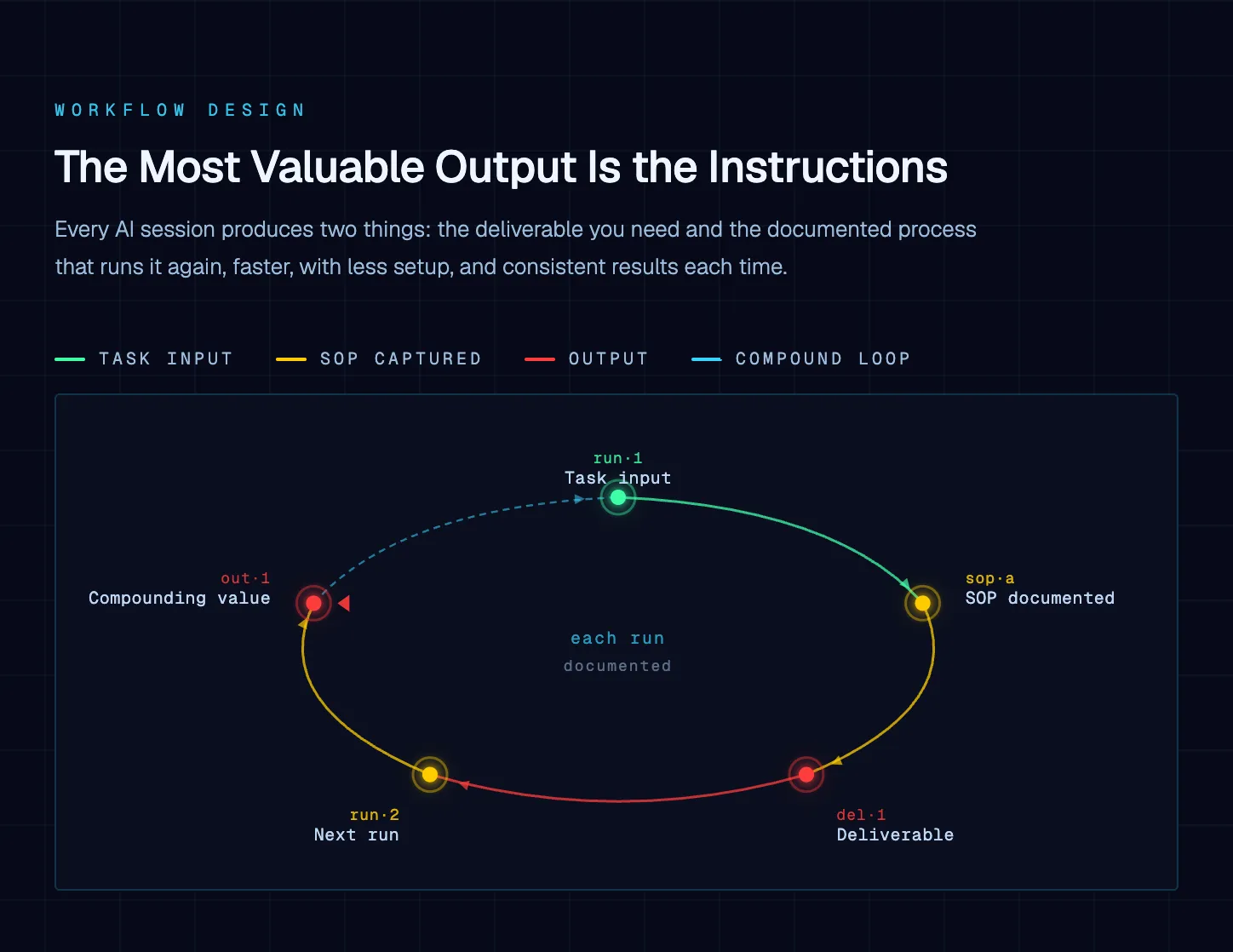
Open a session. Explain the context. Do the work. Close the tab. Start over from scratch next time.
That’s a recurring tax on your time.
A ChatGPT workflow produces two things every time it runs: the output you need, and the documented process that produces that output again – faster, with less setup, and more consistent results. Each time you run it, it costs less. Each time you skip documenting it, you pay the full price again next session.
That’s the capture move – every session produces both the output and the prepared instructions that produce it again.
Three examples show what that difference looks like – and what it’s worth.
Why Starting From Scratch Costs More Than You Think
Every time you open a blank ChatGPT session to do a task you’ve done before, you’re rebuilding context that already exists in your head or your files. You re-explain what the report needs to cover. You re-specify the tone. You re-describe who the audience is. You re-establish what good output looks like.
That context is organizational knowledge. It belongs in the session – not reassembled from memory each time.
The cost shows up in three places: time spent re-explaining, inconsistent outputs when the re-explanation is incomplete, and the inability to hand the task to anyone else because the instructions only exist in your head.
A documented workflow fixes all three. It’s the difference between a task you do and a process you run.
Three Examples
Quarterly Client Report: From Multi-Hour Session to Upload and Execute
A consulting firm produced a quarterly program update for a client. The report covered participant engagement, program outcomes, and qualitative themes drawn from participant feedback forms. Each quarter, producing it meant a multi-hour AI chat session: loading the data, building the structure from scratch, pulling the right quotes, calibrating the tone, and writing eight sections to a specific format.
One session changed that. Instead of producing only the report, it produced two things: the report itself, and a reusable standard operating procedure (SOP) capturing everything the process required. Section structure. Quote selection criteria – what makes a quote worth including, what disqualifies one. Metric calculations that stay consistent quarter over quarter. Tone guidelines calibrated to the client’s preferences.
The SOP also made a distinction that mattered: the difference between project-level instructions (permanent – how this report always works) and task-level instructions (specific to one quarter – what’s different this time). Mixing them muddles what’s a standing rule and what’s a one-time variable. Keeping them separate means the SOP never needs to be rewritten, only the task notes updated.
The next quarter ran differently. The SOP became activation material – load the CSV, reference the SOP, execute. The multi-hour session became a 20-minute task. Across four quarters a year, that’s a full day of work recovered annually – and a client deliverable that compounds rather than resets each cycle.
Content Summary Workflow: A Recurring Task That Stopped Being One
A content producer needed three things prepared each time a new piece of content was published: a meta description formatted as a question, a set of categories drawn from an established taxonomy, and a 100-word overview. Done weekly, across multiple pieces at once.
The session that changed this didn’t just produce the summaries. It documented the process for producing them and encoded it into a reusable workflow file.
The meta description had specific rules: character limits, question format, leading with the reader’s implication rather than the concept inside the piece. Category selection followed a fixed taxonomy – not free tagging, but assignment from a defined list. The overview had a word count, a structure, and a voice guideline.
Once encoded, the workflow ran the same way every time. No re-explaining. No re-specifying. Seven content pieces processed in one session, then the instruction set packaged so the eighth and the hundredth run the same way.
The business value isn’t speed on any single piece. It’s that the task no longer lives only in the head of the person who built it. It can be handed off. It can be audited. It improves rather than degrades over time.
Blog Inventory Workflow: One Prompt, 113 Files
The third example was an audit of an existing body of work.
A business had accumulated a backlog of AI chat sessions documenting client work. That backlog was potential content – case studies, use cases, methodology demonstrations – but it was scattered and unstructured. Before any of it could become a website, it needed to be inventoried.
One prompt was built from existing strategic documents – keyword research, content strategy, and site architecture. The prompt extracted the same information from every session: what was done, what was loaded, what the work produced, and whether the session could become a page on the website.
Applied to the backlog, the prompt produced 113 structured inventory files. Each one the same format. Each one directly usable for content planning.
The prompt runs against every future session added to the backlog. The inventory grows without additional manual work. What would have taken weeks of reading and categorizing hundreds of sessions ran in hours.
One prompt. One hour to build it. Permanent infrastructure.
What These Three Examples Share
Instructions are the asset. A quarterly report is finished when it’s submitted. An SOP runs indefinitely – it can be handed off, updated, audited, and improved. The difference in value is the difference between a deliverable and an asset.
Document the process while you’re doing the task, not after. The quarterly report session produced the SOP alongside the report because both were defined as outputs before the work started. Retroactive documentation rarely happens – the moment passes and the knowledge stays in your head. Defining the SOP as an output before the session starts is what captures it.
A workflow breaks when its instructions live in one person’s head. All three examples produced artifacts – SOPs, workflow files, prompt templates – that exist independently of the person who built them. If the instructions only exist as institutional memory, they leave when the person does.
Related Reading
The quarterly report workflow depends on data in a readable format before the session starts – best file format for ChatGPT covers the conversion step that makes CSV and document data actually usable.
Workflows that pull from a documented knowledge base go further – ChatGPT knowledge base shows how a structured archive changes what the workflow can reference and retrieve.
The prompt that produced 113 files is its own story – AI prompts for business covers how a purpose-built prompt differs from a generic one and what it needs to work.
Want to See This in Your Business?
Book a 30-minute AI Discovery Call where we audit the recurring tasks in your business – reports, summaries, reviews, updates – and identify which ones are ready to become workflows. No deck, no pitch, no obligation.