Activate
Custom AI Assistant: Building a Tool That Knows How You Work
A custom AI assistant isn't a chatbot. It's a specialized tool built from your organizational data. Two examples showing what that looks like when it's working.
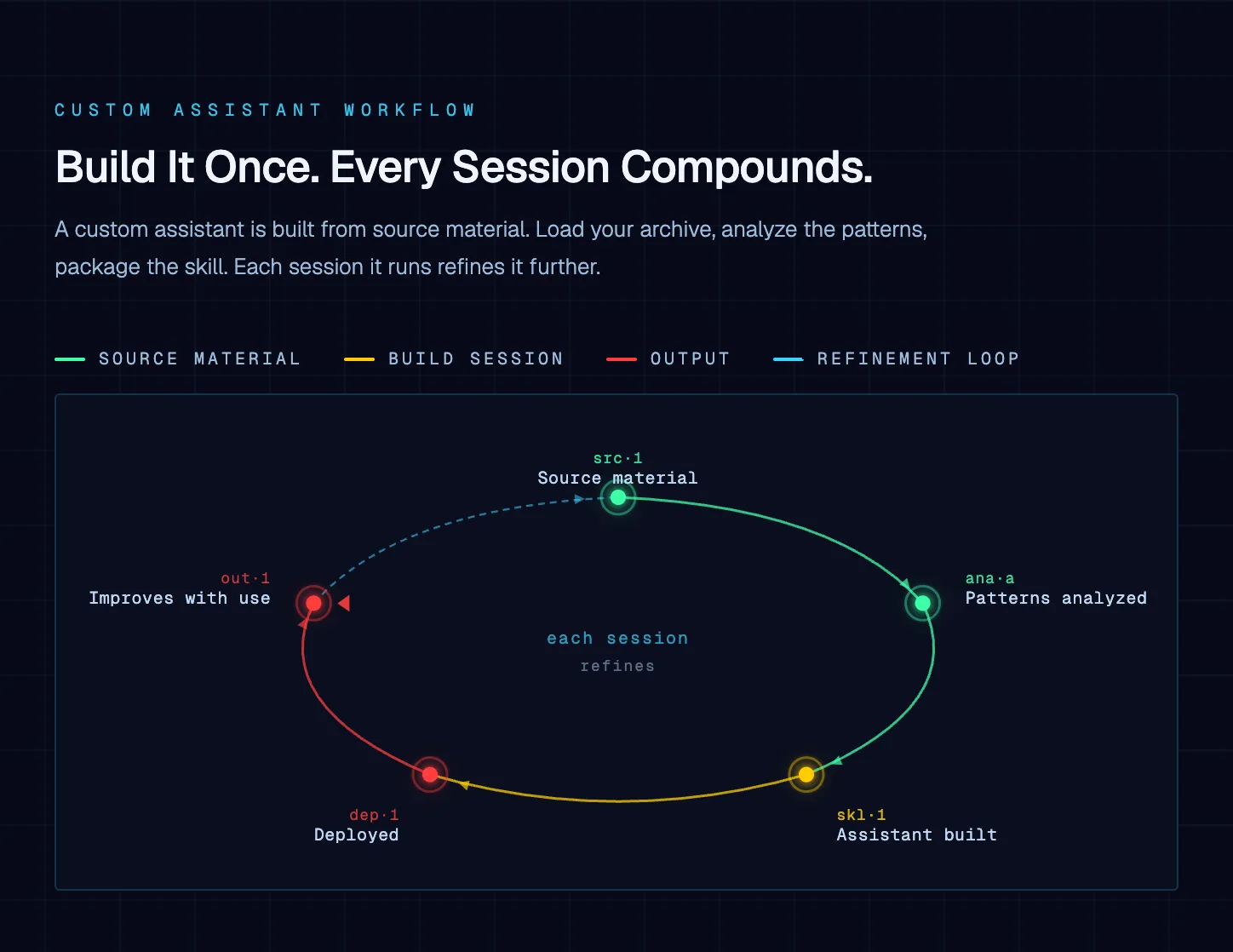
A custom AI assistant is a version of AI that has been built to do a specific job – grounded in your organizational data, trained on how you write, calibrated to what you need.
It does one thing, or a small set of related things, better than a blank AI session could – because it has been loaded with the source material, the style reference, the documented rules, and the examples that make the output specific rather than generic.
The context is already there. Every session starts from the accumulated knowledge of every session before it. There’s no re-explaining.
That’s activation: the body of work loaded into the tool before the first prompt.
What Makes an Assistant Custom
The distinction is in what’s been loaded before the first prompt.
A custom assistant has been loaded with what makes your situation specific: your past content as style reference, your organizational documents as source material, your documented rules and preferences as operating constraints. When you ask it to produce something, it draws from all of that rather than from the internet’s average. The output is calibrated to you.
Building one requires two things: deciding what the assistant is for, and preparing the right source material to make it good at that thing. The clarity of the first decision determines how useful the second one is.
Two Examples
Develop a Writing Style: Two Tools Built in One Session
A practitioner encountered a piece of writing that was exceptional – technically sophisticated content made fully accessible without losing any of its depth. They wanted to understand what made it work and whether that approach could be applied to their own writing.
The session analyzed the source document in detail: the structural moves, the sentence-level patterns, the way abstract ideas were grounded in concrete examples, the rhythm of short and long sentences, the way complexity was earned rather than assumed. From that analysis, a writing style skill was built – not a checklist, but a set of internalized principles that, when applied to a new piece of writing, produced the clarity and rhythm of the original.
A second tool emerged from the same session. The same principles that make writing clear also diagnose why some writing is hard to read. A reading translation tool was built to apply the diagnostic in reverse – taking dense academic or technical content and rendering it in clear, accessible prose for private comprehension without changing the source document.
Two specialized tools. One session. Each built from the analysis of a single source document.
The tools were packaged as installable skill files – saved and available for every future session, ready to be applied and used in future content creation scenarios.
Writing Style Engine – Repeatable Skill: 250 Posts, Fourteen Sessions, One Consistent Voice
A content creator had captured a substantial archive – hundreds of posts written over several years with a recognizable voice and style. The challenge was consistency at scale: producing new content that matched that voice across multiple formats and platforms without manually calibrating each piece from scratch.
The archive went into a project knowledge base. From that corpus, a writing style engine was built – a repeatable skill with an explicit intensity scale from one to five. At level one, the engine lightly shaped new content toward the established voice. At level five, it fully transformed a draft to match the signature style. The scale gave the creator precise control over how closely the output matched their writing without losing the human judgment that had built the voice in the first place.
The engine was deployed across fourteen sessions covering eight different content formats. Two failure modes surfaced through use and were corrected. Over-explaining endings – restating the point already made – was caught and cut. A misattribution of a quote to the wrong speaker was caught before the post went live. Each correction refined the engine. Each session produced output more precisely calibrated than the last.
The engine is a repeatable skill. It transforms a first draft into a final version that matches the voice built over hundreds of posts. The creator’s time shifted from style calibration to substance.
What Both Examples Share
A Custom Assistant Is Built From Source Material. The writing style skill came from analyzing a specific document. The style engine came from loading hundreds of posts. Giving it examples of that voice produces something specific. Source material is what makes the assistant custom.
Build it once, use it indefinitely. Both tools were packaged as installable skills – available in every future session without explanation or setup. The investment is front-loaded. The return compounds with every use.
A custom assistant improves through use. The style engine became more precise over fourteen sessions because each correction was incorporated. An assistant that is used regularly – and whose failures are corrected explicitly – becomes more reliable over time.
Related Reading
A writing style engine runs on a content archive – ChatGPT knowledge base covers how loading past content as source material is what makes a custom assistant specific rather than average.
Style consistency matters most in social media, where volume and frequency make manual calibration unsustainable – ChatGPT for social media shows how the same engine applies across posts and platforms.
A custom assistant built for marketing produces different results than a blank session – ChatGPT for marketing shows what happens when the organizational voice and research are already loaded when the copy session starts.
Want to See This in Your Business?
Book a 30-minute AI Discovery Call where we audit what your business already writes, produces, and documents – and identify which custom assistant would have the most immediate impact. No deck, no pitch, no obligation.